
Join Our JEE Preparation Group
Prep with like-minded aspirants; Get access to free daily tests and study material.
Sign in
Please select an account to continue using cracku.in
↓ →
Join Our JEE Preparation Group
Prep with like-minded aspirants; Get access to free daily tests and study material.
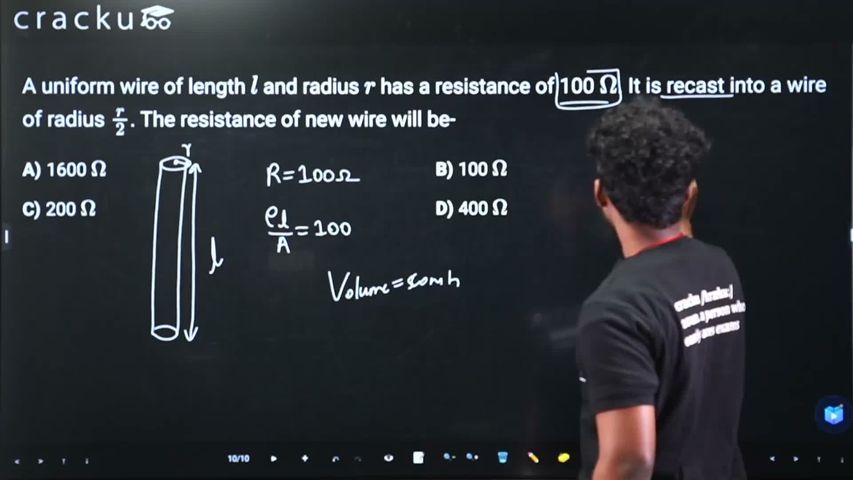
A uniform wire of length $$l$$ and radius $$r$$ has a resistance of 100 $$\Omega$$. It is recast into a wire of radius $$\frac{r}{2}$$. The resistance of new wire will be-
We recall the basic relation between the resistance $$R$$ of a uniform wire, its length $$l$$, cross-sectional area $$A$$ and the material’s resistivity $$\rho$$. The formula is
$$R=\dfrac{\rho\,l}{A}.$$
The wire is melted and redrawn, so the material remains the same; therefore $$\rho$$ is unchanged and the total volume of the wire is conserved. We first write the volume of the original wire:
$$V_{\text{old}}=\pi r^{2}l.$$
After recasting, the new radius becomes $$\dfrac{r}{2}$$ and we denote the new length by $$l_2$$. The new volume must equal the old volume, so
$$V_{\text{new}}=\pi\left(\dfrac{r}{2}\right)^{2}l_2=\pi r^{2}l.$$
We simplify the left side:
$$\pi\left(\dfrac{r}{2}\right)^{2}l_2=\pi\left(\dfrac{r^{2}}{4}\right)l_2=\dfrac{\pi r^{2}l_2}{4}.$$
Equating the two volumes we have
$$\dfrac{\pi r^{2}l_2}{4}=\pi r^{2}l.$$
Dividing by $$\pi r^{2}$$ gives
$$\dfrac{l_2}{4}=l,$$
so
$$l_2=4l.$$
Now we calculate the resistance of the new wire. Its cross-sectional area is
$$A_2=\pi\left(\dfrac{r}{2}\right)^{2}=\dfrac{\pi r^{2}}{4}.$$
Applying the resistance formula to the new wire, we write
$$R_2=\dfrac{\rho\,l_2}{A_2}.$$
Substituting $$l_2=4l$$ and $$A_2=\dfrac{\pi r^{2}}{4}$$, we get
$$R_2=\dfrac{\rho\,(4l)}{\dfrac{\pi r^{2}}{4}}.$$
Dividing by a fraction is the same as multiplying by its reciprocal, so
$$R_2= \rho\,(4l)\left(\dfrac{4}{\pi r^{2}}\right)=16\,\dfrac{\rho\,l}{\pi r^{2}}.$$
But the original resistance is
$$R_1=\dfrac{\rho\,l}{\pi r^{2}}=100\;\Omega.$$
Therefore
$$R_2 = 16R_1 = 16 \times 100\;\Omega = 1600\;\Omega.$$
Hence, the correct answer is Option A.
Was this solution helpful?
Click on the Email ☝️ to Watch the Video Solution
Create a FREE account and get:
_1.webp)

Educational materials for JEE preparation

Ask our AI anything

AI can make mistakes. Please verify important information.
AI can make mistakes. Please verify important information.


