
Join Our JEE Preparation Group
Prep with like-minded aspirants; Get access to free daily tests and study material.
Sign in
Please select an account to continue using cracku.in
↓ →
Join Our JEE Preparation Group
Prep with like-minded aspirants; Get access to free daily tests and study material.
A circular hole of radius $$\frac{R}{4}$$ is made in a thin uniform disc having mass and radius $$R$$, as shown in figure. The moment of inertia of the remaining portion of the disc about an axis passing through the point O and perpendicular to the plane of the disc is-
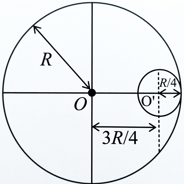
The moment of inertia of a composite system is calculated by subtracting the moment of inertia of the removed portion from the total moment of inertia using the parallel axis theorem.
Given: $$\text{Total radius} = R$$, $$\text{Total mass} = M$$, $$\text{Cutout radius} = r = \frac{R}{4}$$, $$\text{Distance between centers } d = \frac{3R}{4}$$
Mass of the removed circular portion:
$$m = \frac{M}{\pi R^2} \cdot \pi \left(\frac{R}{4}\right)^2 = \frac{M}{16}$$
Moment of inertia of the complete disc about $$O$$:
$$I_{\text{total}} = \frac{1}{2}MR^2$$
Moment of inertia of the removed portion about its own center $$O'$$:
$$I_{\text{cm}} = \frac{1}{2}m\left(\frac{R}{4}\right)^2 = \frac{1}{2}\left(\frac{M}{16}\right)\left(\frac{R^2}{16}\right) = \frac{MR^2}{512}$$
Moment of inertia of the removed portion about axis $$O$$ (using parallel axis theorem):
$$I_{\text{removed}} = I_{\text{cm}} + md^2 = \frac{MR^2}{512} + \left(\frac{M}{16}\right)\left(\frac{3R}{4}\right)^2 = \frac{MR^2}{512} + \frac{9MR^2}{256} = \frac{19MR^2}{512}$$
Moment of inertia of the remaining portion:
$$I_{\text{remaining}} = I_{\text{total}} - I_{\text{removed}} = \frac{1}{2}MR^2 - \frac{19MR^2}{512} = \frac{256MR^2 - 19MR^2}{512} = \frac{237MR^2}{512}$$
Was this solution helpful?
Create a FREE account and get:
_1.webp)

Educational materials for JEE preparation

Ask our AI anything

AI can make mistakes. Please verify important information.
AI can make mistakes. Please verify important information.


