NTA JEE Main 3rd September 2020 Shift 2

Instructions

For the following questions answer them individually

NTA JEE Main 3rd September 2020 Shift 2 - Question 1


Amount of solar energy received on the earth's surface per unit area per unit time is defined a solar constant. Dimension of solar constant is:

NTA JEE Main 3rd September 2020 Shift 2 - Question 2


A particle is moving unidirectional on a horizontal plane under the action of a constant power supplying energy source. The displacement (s) - time (t) graph that describes the motion of the particle is (graphs are drawn schematically and are not to scale):

NTA JEE Main 3rd September 2020 Shift 2 - Question 3


Hydrogen ion and singly ionized helium atom are accelerated, from rest, through the same potential difference. The ratio of final speeds of hydrogen and helium ions is close to:

NTA JEE Main 3rd September 2020 Shift 2 - Question 4


A block of mass 1.9 kg is at rest at the edge of a table, of height 1 m. A bullet of mass 0.1 kg collides with the block and sticks to it. If the velocity of the bullet is 20 m s$$^{-1}$$ in the horizontal direction just before the collision then the kinetic energy just before the combined system strikes the floor, is [Take g = 10 m s$$^{-2}$$. Assume there is no rotational motion and loss of energy after the collision is negligible.]

NTA JEE Main 3rd September 2020 Shift 2 - Question 5


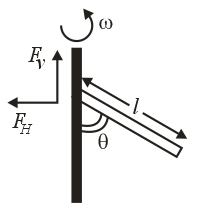
A uniform rod of length '$$\ell$$' is pivoted at one of its ends on a vertical shaft of negligible radius. When the shaft rotates at angular speed $$\omega$$ the rod makes an angle $$\theta$$ with it (see figure). To find $$\theta$$ equate the rate of change of angular momentum (direction going into the paper) $$\frac{m\ell^2}{12}\omega^2 \sin\theta$$ about the centre of mass (CM) to the torque provided by the horizontal and vertical forces $$F_H$$ and $$F_v$$ about the CM. The value of $$\theta$$ is then such that:

NTA JEE Main 3rd September 2020 Shift 2 - Question 6


The mass density of a planet of radius R varies with the distance r from its centre as $$\rho(r) = \rho_0\left(1 - \frac{r^2}{R^2}\right)$$. Then the gravitational field is maximum at:

NTA JEE Main 3rd September 2020 Shift 2 - Question 7


A metallic sphere cools from 50°C to 40°C in 300 s. If atmospheric temperature around is 20°C, then the sphere's temperature after the next 5 minutes will be close to:

NTA JEE Main 3rd September 2020 Shift 2 - Question 8


A calorimeter of water equivalent 20 g contains 180 g of water at 25°C. 'm' grams of steam at 100°C is mixed in it till the temperature of the mixture is 31°C. The value of 'm' is close to (Latent heat of water = 540 cal g$$^{-1}$$, specific heat of water = 1 cal g$$^{-1}$$°C$$^{-1}$$)

NTA JEE Main 3rd September 2020 Shift 2 - Question 9


To raise the temperature of a certain mass of gas by 50°C at a constant pressure, 160 calories of heat is required. When the same mass of gas is cooled by 100°C at constant volume, 240 calories of heat is released. How many degrees of freedom does each molecule of this gas have (assume gas to be ideal)?

NTA JEE Main 3rd September 2020 Shift 2 - Question 10


A block of mass m attached to a massless spring is performing oscillatory motion of amplitude 'A' on a frictionless horizontal plane. If half of the mass of the block breaks off when it is passing through its equilibrium point, the amplitude of oscillation for the remaining system become $$fA$$. The value of $$f$$ is:

banner

banner
cracku

Boost your Prep!

Download App