
Join Our JEE Preparation Group
Prep with like-minded aspirants; Get access to free daily tests and study material.
Sign in
Please select an account to continue using cracku.in
↓ →
Join Our JEE Preparation Group
Prep with like-minded aspirants; Get access to free daily tests and study material.
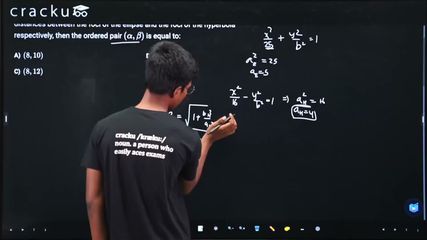
Let $$e_1$$ and $$e_2$$ be the eccentricities of the ellipse $$\frac{x^2}{25} + \frac{y^2}{b^2} = 1$$ $$(b < 5)$$ and the hyperbola $$\frac{x^2}{16} - \frac{y^2}{b^2} = 1$$ respectively satisfying $$e_1 e_2 = 1$$. If $$\alpha$$ and $$\beta$$ are the distances between the foci of the ellipse and the foci of the hyperbola respectively, then the ordered pair $$(\alpha, \beta)$$ is equal to:
We have an ellipse whose equation is $$\dfrac{x^2}{25} + \dfrac{y^2}{b^2} = 1,\; (b < 5).$$
For any ellipse of the form $$\dfrac{x^2}{a^2} + \dfrac{y^2}{b^2} = 1$$ with its major axis along the $$x$$-axis, the standard results are
$$a^2 = \text{denominator of }x^2,\quad b^2 = \text{denominator of }y^2,$$
$$c^2 = a^2 - b^2,\quad e = \dfrac{c}{a},$$
where $$c$$ is the semi-focal distance and $$e$$ is the eccentricity.
Comparing, we identify $$a^2 = 25$$ and $$b^2 = b^2$$ itself. Therefore
$$c_1^2 = a^2 - b^2 = 25 - b^2,$$
so $$c_1 = \sqrt{25 - b^2}.$$
Hence the eccentricity of the ellipse is
$$e_1 = \dfrac{c_1}{a} = \dfrac{\sqrt{25 - b^2}}{5}.$$
Next we have a hyperbola whose equation is $$\dfrac{x^2}{16} - \dfrac{y^2}{b^2} = 1.$$
For any hyperbola of the form $$\dfrac{x^2}{a^2} - \dfrac{y^2}{b^2} = 1,$$ the corresponding formulas are
$$a^2 = \text{denominator of }x^2,\quad b^2 = \text{denominator of }y^2,$$
$$c^2 = a^2 + b^2,\quad e = \dfrac{c}{a},$$
because in a hyperbola the relationship involves a plus sign in $$c^2 = a^2 + b^2.$$
Here $$a^2 = 16$$ and again $$b^2 = b^2.$$ Thus
$$c_2^2 = a^2 + b^2 = 16 + b^2,$$
so $$c_2 = \sqrt{16 + b^2}.$$
The eccentricity of the hyperbola is therefore
$$e_2 = \dfrac{c_2}{a} = \dfrac{\sqrt{16 + b^2}}{4}.$$
The condition given in the problem is $$e_1 e_2 = 1.$$ Substituting the expressions we have just derived,
$$\left(\dfrac{\sqrt{25 - b^2}}{5}\right) \left(\dfrac{\sqrt{16 + b^2}}{4}\right) = 1.$$
Multiplying the numerators and denominators separately we get
$$\dfrac{\sqrt{(25 - b^2)(16 + b^2)}}{20} = 1.$$
Now multiply both sides by $$20$$:
$$\sqrt{(25 - b^2)(16 + b^2)} = 20.$$
To remove the square root we square both sides:
$$(25 - b^2)(16 + b^2) = 400.$$
Expanding the left-hand side step by step,
$$25 \times 16 + 25 b^2 - 16 b^2 - b^4 = 400.$$
The product $$25 \times 16 = 400,$$ so we have
$$400 + 25 b^2 - 16 b^2 - b^4 = 400.$$
Combining the like terms in $$b^2$$ gives
$$400 + 9 b^2 - b^4 = 400.$$
Subtract $$400$$ from both sides:
$$9 b^2 - b^4 = 0.$$
Factor out $$b^2$$:
$$b^2 (9 - b^2) = 0.$$
The factor $$b^2 = 0$$ is inadmissible because the denominators in the original equations would vanish. Therefore,
$$9 - b^2 = 0 \quad \Longrightarrow \quad b^2 = 9.$$
Since $$b > 0$$ and the problem states $$b < 5,$$ we choose
$$b = 3.$$
Now we can compute the quantities asked for. First, the distance between the two foci of the ellipse is
$$\alpha = 2 c_1 = 2 \sqrt{25 - b^2} = 2 \sqrt{25 - 9} = 2 \times 4 = 8.$$
Next, the distance between the two foci of the hyperbola is
$$\beta = 2 c_2 = 2 \sqrt{16 + b^2} = 2 \sqrt{16 + 9} = 2 \times 5 = 10.$$
Hence the ordered pair is $$(\alpha, \beta) = (8, 10).$$
Looking at the options, this matches Option A.
Hence, the correct answer is Option A.
Was this solution helpful?
Click on the Email ☝️ to Watch the Video Solution
Create a FREE account and get:
_1.webp)

Educational materials for JEE preparation

Ask our AI anything

AI can make mistakes. Please verify important information.
AI can make mistakes. Please verify important information.
