
Join Our JEE Preparation Group
Prep with like-minded aspirants; Get access to free daily tests and study material.
Sign in
Please select an account to continue using cracku.in
↓ →
Join Our JEE Preparation Group
Prep with like-minded aspirants; Get access to free daily tests and study material.
$$\lim_{x \to a}\frac{(a+2x)^{\frac{1}{3}} - (3x)^{\frac{1}{3}}}{(3a+x)^{\frac{1}{3}} - (4x)^{\frac{1}{3}}}$$ $$(a \neq 0)$$ is equal to:
We have to evaluate the limit
$$L=\lim_{x \to a}\dfrac{(a+2x)^{\frac13}-(3x)^{\frac13}}{(3a+x)^{\frac13}-(4x)^{\frac13}}, \qquad (a\neq 0).$$
First we check what happens when we directly put $$x=a$$:
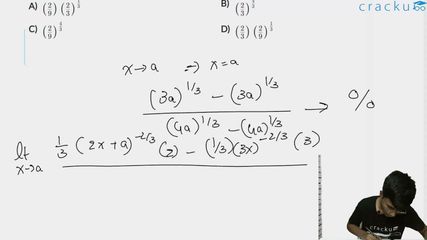
$$\text{Numerator at }x=a=(a+2a)^{\frac13}-(3a)^{\frac13}=(3a)^{\frac13}-(3a)^{\frac13}=0,$$
$$\text{Denominator at }x=a=(3a+a)^{\frac13}-(4a)^{\frac13}=(4a)^{\frac13}-(4a)^{\frac13}=0.$$
Thus the limit is of the indeterminate form $$0/0$$. Consequently we can apply L’Hospital’s Rule, which states:
$$\text{If }\displaystyle\lim_{x\to c}\dfrac{f(x)}{g(x)}=\dfrac{0}{0}\text{ or }\dfrac{\infty}{\infty},\ \text{then }\displaystyle\lim_{x\to c}\dfrac{f(x)}{g(x)}=\lim_{x\to c}\dfrac{f'(x)}{g'(x)},$$
provided the latter limit exists.
So we differentiate the numerator and the denominator with respect to $$x$$. We recall the derivative formula
$$\dfrac{d}{dx}\bigl(u^{1/3}\bigr)=\dfrac{1}{3}\,u^{-2/3}\,\dfrac{du}{dx}.$$
Numerator:
$$f(x)=(a+2x)^{\frac13}-(3x)^{\frac13}.$$
Using the above formula,
$$f'(x)=\dfrac{1}{3}(a+2x)^{-\frac23}\cdot 2-\dfrac{1}{3}(3x)^{-\frac23}\cdot 3.$$
Simplifying each term gives
$$f'(x)=\dfrac{2}{3\,(a+2x)^{\frac23}}-(3x)^{-\frac23}.$$
Now we evaluate at $$x=a$$:
$$f'(a)=\dfrac{2}{3\,(a+2a)^{\frac23}}-(3a)^{-\frac23} =\dfrac{2}{3\,(3a)^{\frac23}}-(3a)^{-\frac23}.$$
Writing the second term with the same base factor,
$$f'(a)=\dfrac{2}{3}(3a)^{-\frac23}-(3a)^{-\frac23} =\left(\dfrac{2}{3}-1\right)(3a)^{-\frac23} =-\dfrac{1}{3}(3a)^{-\frac23}.$$
So
$$f'(a)=-\dfrac{1}{3(3a)^{\frac23}}.$$
Denominator:
$$g(x)=(3a+x)^{\frac13}-(4x)^{\frac13}.$$
Differentiating,
$$g'(x)=\dfrac{1}{3}(3a+x)^{-\frac23}\cdot 1-\dfrac{1}{3}(4x)^{-\frac23}\cdot 4.$$
Hence
$$g'(x)=\dfrac{1}{3(3a+x)^{\frac23}}-\dfrac{4}{3(4x)^{\frac23}}.$$
Putting $$x=a$$ gives
$$g'(a)=\dfrac{1}{3(3a+a)^{\frac23}}-\dfrac{4}{3(4a)^{\frac23}} =\dfrac{1}{3(4a)^{\frac23}}-\dfrac{4}{3(4a)^{\frac23}} =\dfrac{1-4}{3(4a)^{\frac23}} =-\dfrac{1}{(4a)^{\frac23}}.$$
Applying L’Hospital’s Rule:
$$L=\dfrac{f'(a)}{g'(a)} =\dfrac{-\dfrac{1}{3(3a)^{\frac23}}}{-\dfrac{1}{(4a)^{\frac23}}} =\dfrac{(4a)^{\frac23}}{3(3a)^{\frac23}}.$$
We separate the powers of $$a$$ and simplify the numerical ratio:
$$L=\dfrac{1}{3}\,\dfrac{(4a)^{\frac23}}{(3a)^{\frac23}} =\dfrac{1}{3}\left(\dfrac{4a}{3a}\right)^{\frac23} =\dfrac{1}{3}\left(\dfrac{4}{3}\right)^{\frac23}.$$
Since $$4=2^{2}$$, we write
$$\left(\dfrac{4}{3}\right)^{\frac23} =\left(\dfrac{2^{2}}{3}\right)^{\frac23} =\dfrac{2^{\frac43}}{3^{\frac23}}.$$
Therefore
$$L=\dfrac{1}{3}\cdot\dfrac{2^{\frac43}}{3^{\frac23}} =\dfrac{2^{\frac43}}{3^{1+\frac23}} =\dfrac{2^{\frac43}}{3^{\frac53}}.$$
We now express this in the form appearing in the options. Notice that
$$\dfrac{2^{\frac43}}{3^{\frac53}} =\dfrac{2}{3}\cdot\dfrac{2^{\frac13}}{3^{\frac23}} =\left(\dfrac{2}{3}\right)\left(\dfrac{2}{9}\right)^{\frac13}.$$
This matches Option D.
Hence, the correct answer is Option D.
Was this solution helpful?
Click on the Email ☝️ to Watch the Video Solution
Create a FREE account and get:
_1.webp)

Educational materials for JEE preparation

Ask our AI anything

AI can make mistakes. Please verify important information.
AI can make mistakes. Please verify important information.
