
Join Our JEE Preparation Group
Prep with like-minded aspirants; Get access to free daily tests and study material.
Sign in
Please select an account to continue using cracku.in
↓ →
Join Our JEE Preparation Group
Prep with like-minded aspirants; Get access to free daily tests and study material.
Let a plane $$P$$ contain two lines $$\vec{r} = \hat{i} + \lambda(\hat{i} + \hat{j})$$, $$\lambda \in R$$ and $$\vec{r} = -\hat{j} + \mu(\hat{j} - \hat{k})$$, $$\mu \in R$$. If $$Q(\alpha, \beta, \gamma)$$ is the foot of the perpendicular drawn from the point M(1, 0, 1) to P, then $$3(\alpha + \beta + \gamma)$$ equals .......
Correct Answer: 5
We are told that the plane $$P$$ contains the two lines
$$\vec r=\hat i+\lambda(\hat i+\hat j),\qquad\lambda\in\mathbb R$$
and
$$\vec r=-\hat j+\mu(\hat j-\hat k),\qquad\mu\in\mathbb R.$$
From the first line we read the point $$A(1,0,0)$$ (the position vector $$\hat i$$) and the direction vector $$\vec d_1=(1,1,0)$$ (coming from $$\hat i+\hat j$$).
From the second line we read the point $$B(0,-1,0)$$ (the position vector $$-\hat j$$) and the direction vector $$\vec d_2=(0,1,-1)$$ (coming from $$\hat j-\hat k$$).
Any plane passing through two non-parallel direction vectors has as normal vector their cross product. Therefore, first we compute
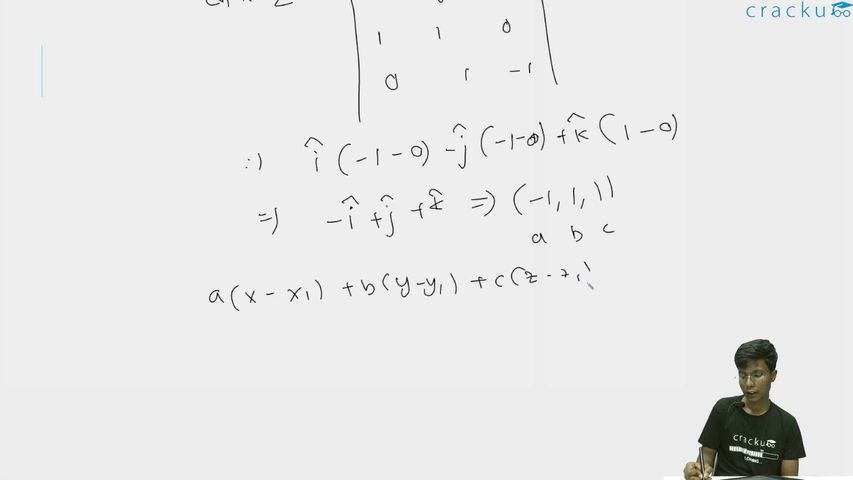
$$\vec n=\vec d_1\times\vec d_2= \begin{vmatrix} \hat i & \hat j & \hat k\\[2pt] 1 & 1 & 0\\[2pt] 0 & 1 & -1 \end{vmatrix} =\hat i(1\cdot(-1)-0\cdot1)-\hat j(1\cdot(-1)-0\cdot0)+\hat k(1\cdot1-0\cdot1) =(-1,1,1).$$
Thus a convenient normal vector is $$\vec n=(-1,1,1).$$
The general equation of a plane with normal vector $$(a,b,c)$$ passing through a fixed point $$(x_1,y_1,z_1)$$ is
$$a(x-x_1)+b(y-y_1)+c(z-z_1)=0.$$
Taking $$a=-1,\;b=1,\;c=1$$ and $$(x_1,y_1,z_1)=(1,0,0)$$ we get
$$ -1(x-1)+1(y-0)+1(z-0)=0 \;\Longrightarrow\; -x+1+y+z=0 \;\Longrightarrow\; x-y-z-1=0. $$
So the plane $$P$$ has the Cartesian equation
$$x-y-z-1=0.$$ Writing it in the standard form $$ax+by+cz+d=0$$ we have $$a=1,\;b=-1,\;c=-1,\;d=-1.$$
Now we must find the foot of the perpendicular from the point $$M(1,0,1)$$ to this plane. For a plane $$ax+by+cz+d=0$$ and a point $$(x_0,y_0,z_0),$$ the projection (foot of the perpendicular) $$(x_1,y_1,z_1)$$ is obtained by the formula
$$ (x_1,y_1,z_1)=(x_0,y_0,z_0)-\frac{a x_0+b y_0+c z_0+d}{a^2+b^2+c^2}\,(a,b,c). $$
First we evaluate the numerator:
$$ a x_0+b y_0+c z_0+d =1\cdot1+(-1)\cdot0+(-1)\cdot1+(-1) =1+0-1-1=-1. $$
Next we evaluate the denominator:
$$ a^2+b^2+c^2 =1^2+(-1)^2+(-1)^2 =1+1+1=3. $$
Hence
$$ k=\frac{a x_0+b y_0+c z_0+d}{a^2+b^2+c^2} =\frac{-1}{3}=-\frac13. $$
Therefore
$$ (x_1,y_1,z_1)=(1,0,1)-\left(-\frac13\right)(1,-1,-1) =(1,0,1)+\frac13(1,-1,-1). $$
Carrying out the scalar multiplication and addition coordinate-wise:
$$ x_1=1+\frac13=\frac43,\qquad y_1=0-\frac13=-\frac13,\qquad z_1=1-\frac13=\frac23. $$
Thus the foot of the perpendicular is $$Q(\alpha,\beta,\gamma)=\left(\frac43,\;-\frac13,\;\frac23\right).$$
Now we need $$3(\alpha+\beta+\gamma).$$ First we add the three coordinates:
$$ \alpha+\beta+\gamma =\frac43-\frac13+\frac23 =\frac{4-1+2}{3} =\frac{5}{3}. $$
Multiplying by 3 gives
$$ 3(\alpha+\beta+\gamma)=3\cdot\frac53=5. $$
So, the answer is $$5$$.
Was this solution helpful?
Click on the Email ☝️ to Watch the Video Solution
Create a FREE account and get:
_1.webp)

Educational materials for JEE preparation

Ask our AI anything

AI can make mistakes. Please verify important information.
AI can make mistakes. Please verify important information.
