
Join Our JEE Preparation Group
Prep with like-minded aspirants; Get access to free daily tests and study material.
Sign in
Please select an account to continue using cracku.in
↓ →
Join Our JEE Preparation Group
Prep with like-minded aspirants; Get access to free daily tests and study material.
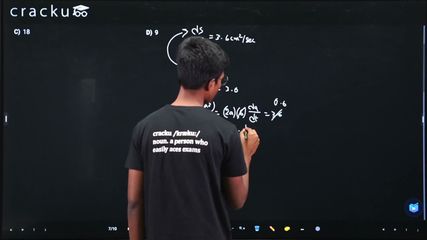
If the surface area of a cube is increasing at a rate of 3.6 cm$$^2$$/sec, retaining its shape; then the rate of change of its volume (in cm$$^3$$/sec), when the length of a side of the cube is 10 cm, is:
We consider a cube whose edge length (side) at any instant is denoted by $$a \;{\rm cm}$$. Two basic geometrical relations for a cube are needed.
First, the surface area $$S$$ of a cube is given by the formula
$$S \;=\; 6a^{2}.$$
Second, the volume $$V$$ of a cube is given by the formula
$$V \;=\; a^{3}.$$
Both $$S$$ and $$V$$ are changing with time because the edge length $$a$$ itself is changing with time. Let $$\dfrac{dS}{dt}$$ and $$\dfrac{dV}{dt}$$ denote their respective rates of change, and let $$\dfrac{da}{dt}$$ be the rate at which the edge length changes.
We are told that the surface area is increasing at a constant rate of $$3.6\;{\rm cm^{2}/s}$$, so
$$\dfrac{dS}{dt} \;=\; 3.6.$$
Our target is $$\dfrac{dV}{dt}$$ when $$a = 10\;{\rm cm}$$.
We begin by differentiating the surface‐area formula with respect to time $$t$$. Since $$S = 6a^{2}$$, we have
$$\frac{dS}{dt} \;=\; \frac{d}{dt}\bigl(6a^{2}\bigr) \;=\; 6 \cdot 2a \cdot \frac{da}{dt} \;=\; 12a\,\frac{da}{dt}.$$
Now we solve this relation for $$\dfrac{da}{dt}$$:
$$\frac{da}{dt} \;=\; \frac{1}{12a}\,\frac{dS}{dt}.$$
Substituting the given value $$\dfrac{dS}{dt}=3.6$$ and the specific edge length $$a = 10$$, we obtain
$$\frac{da}{dt} \;=\; \frac{1}{12 \times 10}\,(3.6) \;=\; \frac{3.6}{120} \;=\; 0.03\;{\rm cm/s}.$$
Next, we differentiate the volume formula. From $$V = a^{3}$$,
$$\frac{dV}{dt} \;=\; \frac{d}{dt}\bigl(a^{3}\bigr) \;=\; 3a^{2}\,\frac{da}{dt}.$$
We already know $$a = 10$$ and $$\dfrac{da}{dt} = 0.03$$, so substitute these values:
$$\frac{dV}{dt} \;=\; 3 \times (10)^{2} \times 0.03 \;=\; 3 \times 100 \times 0.03 \;=\; 300 \times 0.03 \;=\; 9\;{\rm cm^{3}/s}.$$
Therefore, the volume of the cube is increasing at the rate of $$9\;{\rm cm^{3}/s}$$ when the edge length is $$10\;{\rm cm}$$.
Hence, the correct answer is Option D.
Was this solution helpful?
Click on the Email ☝️ to Watch the Video Solution
Create a FREE account and get:
_1.webp)

Educational materials for JEE preparation

Ask our AI anything

AI can make mistakes. Please verify important information.
AI can make mistakes. Please verify important information.
