
Join Our JEE Preparation Group
Prep with like-minded aspirants; Get access to free daily tests and study material.
Sign in
Please select an account to continue using cracku.in
↓ →
Join Our JEE Preparation Group
Prep with like-minded aspirants; Get access to free daily tests and study material.
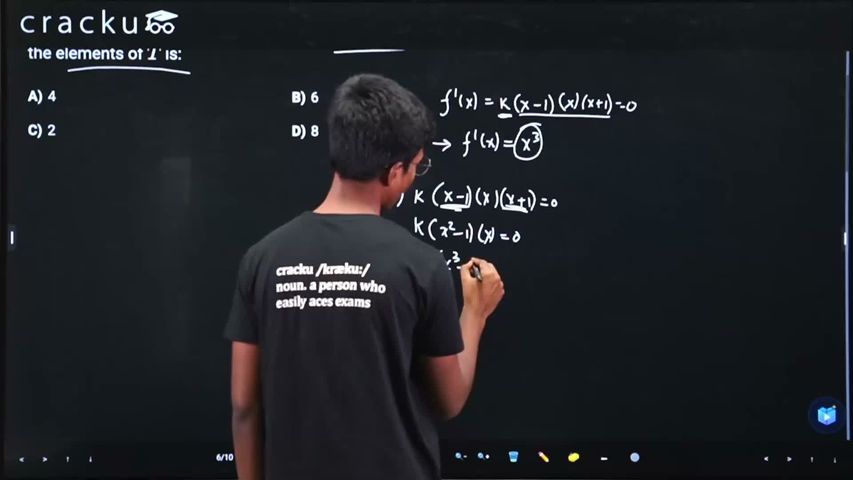
Suppose $$f(x)$$ is a polynomial of degree four having critical points at -1, 0, 1. If $$T = \{x \in R | f(x) = f(0)\}$$, then the sum of squares of all the elements of $$T$$ is:
We begin with the information that the polynomial $$f(x)$$ is of degree four and possesses the three critical points $$x=-1,\;0,\;1$$.
By definition, a critical point is a root of the first derivative. Hence we must have
$$f'(x)=0 \quad\text{when}\quad x=-1,\,0,\,1.$$
A fourth-degree polynomial has a third-degree derivative. Therefore the derivative can have at most three roots, and here all three are already specified. Thus those three roots account for the entire derivative, so the derivative must be proportional to the cubic factor that vanishes at these points:
$$f'(x)=k\,(x+1)\,x\,(x-1),$$
where $$k\neq0$$ is a constant of proportionality.
We next expand the cubic for convenience:
$$ (x+1)\,x\,(x-1)=x\,(x^2-1)=x^3-x. $$
So the derivative is explicitly
$$f'(x)=k\,(x^3-x).$$
To recover $$f(x)$$ itself we integrate. We recall the elementary antiderivatives:
$$\int x^3\,dx=\frac{x^4}{4},\qquad\int x\,dx=\frac{x^2}{2}.$$
Applying term-by-term integration and keeping the constant of integration $$C$$, we obtain
$$\begin{aligned} f(x) &= k\int (x^3-x)\,dx + C \\ &= k\left(\frac{x^4}{4}-\frac{x^2}{2}\right)+C. \end{aligned}$$
Thus
$$f(x)=\frac{k}{4}\,x^4-\frac{k}{2}\,x^2+C.$$
Now we form the set
$$T=\{x\in\mathbb R\mid f(x)=f(0)\}.$$
First compute $$f(0)$$ directly:
$$f(0)=\frac{k}{4}(0)^4-\frac{k}{2}(0)^2+C=C.$$
So the defining condition for membership in $$T$$ is
$$f(x)=C.$$
Substituting the explicit formula for $$f(x)$$ gives
$$\frac{k}{4}\,x^4-\frac{k}{2}\,x^2+C=C.$$
Subtracting $$C$$ from both sides simplifies to
$$\frac{k}{4}\,x^4-\frac{k}{2}\,x^2=0.$$
Because $$k\neq0$$ we may divide through by $$k$$ and then multiply by $$4$$ to clear the fraction:
$$x^4-2x^2=0.$$
We factor completely:
$$x^2\,(x^2-2)=0.$$
This yields two separate equations:
$$x^2=0 \quad\text{or}\quad x^2=2.$$
Solving each gives the real elements of $$T$$:
$$x=0,\quad x=\sqrt2,\quad x=-\sqrt2.$$
Hence
$$T=\{\,0,\;\sqrt2,\;-\sqrt2\,\}.$$
We are asked for the sum of the squares of all elements of $$T$$. Squaring each element we have
$$0^2=0,\qquad(\sqrt2)^2=2,\qquad(-\sqrt2)^2=2.$$
Adding these results:
$$0+2+2=4.$$
Hence, the correct answer is Option A.
Was this solution helpful?
Click on the Email ☝️ to Watch the Video Solution
Create a FREE account and get:
_1.webp)

Educational materials for JEE preparation

Ask our AI anything

AI can make mistakes. Please verify important information.
AI can make mistakes. Please verify important information.
