
Join Our JEE Preparation Group
Prep with like-minded aspirants; Get access to free daily tests and study material.
Sign in
Please select an account to continue using cracku.in
↓ →
Join Our JEE Preparation Group
Prep with like-minded aspirants; Get access to free daily tests and study material.
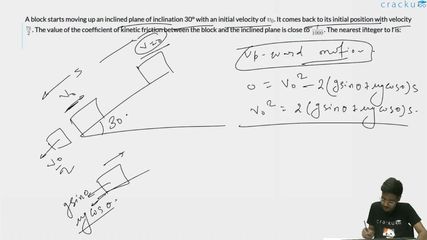
A block starts moving up an inclined plane of inclination 30° with an initial velocity of $$v_0$$. It comes back to its initial position with velocity $$\frac{v_0}{2}$$. The value of the coefficient of kinetic friction between the block and the inclined plane is close to $$\frac{I}{1000}$$. The nearest integer to I is:
Correct Answer: 346
We have a block that is projected up an inclined plane making an angle $$\theta = 30^{\circ}$$ with the horizontal. The initial velocity is $$v_0$$. While the block slides, kinetic friction acts opposite to its motion, and the coefficient of kinetic friction is $$\mu_k$$ (we shall write it simply as $$\mu$$). The block first moves upward, stops momentarily, and then slides back down to its starting point with speed $$\dfrac{v_0}{2}$$.
Let the upward direction along the plane be positive. The forces along the plane are the component of gravity $$mg\sin\theta$$ (down the plane) and the kinetic friction force $$\mu mg\cos\theta$$ (also down the plane because motion is upward). Hence, during the upward motion the net acceleration is
$$a_1 = -\bigl(g\sin\theta + \mu g\cos\theta\bigr).$$
The block starts with speed $$v_0$$ and comes to rest after travelling some distance $$s$$ up the plane, so we use the constant-acceleration relation (first state the formula):
For motion with initial speed $$u$$, final speed $$v$$, acceleration $$a$$ and displacement $$s$$, the kinematic equation is $$v^{2}=u^{2}+2as$$. Applying it upward,
$$0^{2}=v_0^{2}+2\,a_1\,s \;\Longrightarrow\; 0=v_0^{2}+2\bigl(-g\sin\theta-\mu g\cos\theta\bigr)s.$$
Re-arranging,
$$v_0^{2}=2\bigl(g\sin\theta+\mu g\cos\theta\bigr)s,$$
so
$$s=\dfrac{v_0^{2}}{2\bigl(g\sin\theta+\mu g\cos\theta\bigr)}. \quad -(1)$$
Now the block slides back down. While it moves downward, gravity’s component $$mg\sin\theta$$ is down the plane (this time along the direction of motion) but friction $$\mu mg\cos\theta$$ is still up the plane, opposing the motion. Thus the net acceleration downward is
$$a_2=g\sin\theta-\mu g\cos\theta.$$
The block starts this return journey from rest (at the top) and gains speed, reaching $$\dfrac{v_0}{2}$$ after descending the same distance $$s$$. Again using $$v^{2}=u^{2}+2as$$ with $$u=0,\;v=\dfrac{v_0}{2},\;a=a_2,\;s=s$$, we get
$$\Bigl(\dfrac{v_0}{2}\Bigr)^{2}=2\,a_2\,s,$$
that is,
$$\dfrac{v_0^{2}}{4}=2\bigl(g\sin\theta-\mu g\cos\theta\bigr)s. \quad -(2)$$
Substituting the value of $$s$$ from equation (1) into equation (2):
$$\dfrac{v_0^{2}}{4}=2\bigl(g\sin\theta-\mu g\cos\theta\bigr)\,\dfrac{v_0^{2}}{2\bigl(g\sin\theta+\mu g\cos\theta\bigr)}.$$
The factor $$v_0^{2}$$ cancels out, and one factor of 2 in numerator and denominator cancels as well, giving
$$\frac{1}{4}=\frac{g\sin\theta-\mu g\cos\theta}{g\sin\theta+\mu g\cos\theta}.$$
The acceleration due to gravity $$g$$ cancels on both numerator and denominator. Putting $$\sin30^{\circ}=\dfrac{1}{2}$$ and $$\cos30^{\circ}=\dfrac{\sqrt3}{2}$$, we have
$$\frac{1}{4}=\frac{\dfrac12-\mu\dfrac{\sqrt3}{2}}{\dfrac12+\mu\dfrac{\sqrt3}{2}}.$$
Multiplying numerator and denominator by 2 to clear the fractions gives
$$\frac{1}{4}=\frac{1-\mu\sqrt3}{1+\mu\sqrt3}.$$
Cross-multiplying,
$$(1+\mu\sqrt3)=4(1-\mu\sqrt3).$$
Expanding the right-hand side,
$$1+\mu\sqrt3=4-4\mu\sqrt3.$$
Now collect the terms containing $$\mu$$ on one side and constants on the other:
$$\mu\sqrt3+4\mu\sqrt3=4-1,$$
which simplifies to
$$5\mu\sqrt3=3.$$
Solving for $$\mu$$,
$$\mu=\frac{3}{5\sqrt3}=\frac{3}{5\times1.732} \approx \frac{3}{8.660} \approx 0.346.$$
The problem states that this value is close to $$\dfrac{I}{1000}$$, so $$I\approx346$$. The nearest integer to $$I$$ is therefore 346.
Hence, the correct answer is Option A: 346.
Was this solution helpful?
Click on the Email ☝️ to Watch the Video Solution
Create a FREE account and get:
_1.webp)

Educational materials for JEE preparation

Ask our AI anything

AI can make mistakes. Please verify important information.
AI can make mistakes. Please verify important information.
