
Join Our JEE Preparation Group
Prep with like-minded aspirants; Get access to free daily tests and study material.
Sign in
Please select an account to continue using cracku.in
↓ →
Join Our JEE Preparation Group
Prep with like-minded aspirants; Get access to free daily tests and study material.
Let $$x_i (1 \leq i \leq 10)$$ be ten observations of a random variable X. If $$\sum_{i=1}^{10}(x_i - p) = 3$$ and $$\sum_{i=1}^{10}(x_i - p)^2 = 9$$ where $$0 \neq p \in R$$, then the standard deviation of these observations is:
We have ten observations $$x_1,x_2,\dots ,x_{10}$$ of the random variable $$X$$. The statements given are
$$\sum_{i=1}^{10}(x_i-p)=3 \qquad\text{and}\qquad \sum_{i=1}^{10}(x_i-p)^2=9,$$
where $$p\neq 0,\;p\in\mathbb R.$$ Our task is to find the standard deviation of the ten observations.
First recall that the (population) mean $$\mu$$ of the observations is defined by the formula
$$\mu=\frac1{10}\sum_{i=1}^{10}x_i.$$
To express $$\mu$$ in terms of the known quantity $$p$$, we write every $$x_i$$ as $$(x_i-p)+p$$ and sum:
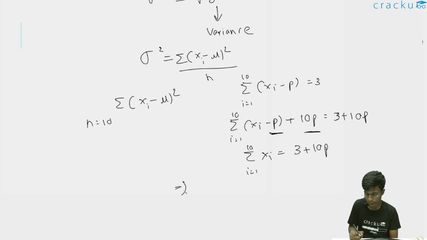
$$\sum_{i=1}^{10}x_i=\sum_{i=1}^{10}\bigl[(x_i-p)+p\bigr] =\sum_{i=1}^{10}(x_i-p)+10p =3+10p.$$
Hence the mean is
$$\mu=\frac{3+10p}{10}=p+\frac{3}{10}.$$
Now the (population) variance $$\sigma^{2}$$ is defined by
$$\sigma^{2}=\frac1{10}\sum_{i=1}^{10}(x_i-\mu)^2.$$
We already know $$\sum_{i=1}^{10}(x_i-p)^2$$, so we convert the squared deviations from $$\mu$$ to squared deviations from $$p$$ using the identity
$$(x_i-\mu)^2=\bigl[(x_i-p)-( \mu-p)\bigr]^2.$$ Expanding gives
$$(x_i-\mu)^2=(x_i-p)^2-2(\mu-p)(x_i-p)+(\mu-p)^2.$$
Summing this expression over all ten indices, we obtain
$$\sum_{i=1}^{10}(x_i-\mu)^2 =\sum_{i=1}^{10}(x_i-p)^2-2(\mu-p)\sum_{i=1}^{10}(x_i-p)+10(\mu-p)^2.$$
Every term on the right is known: we have $$\sum_{i=1}^{10}(x_i-p)^2=9,$$ $$\sum_{i=1}^{10}(x_i-p)=3,$$ and $$\mu-p=\frac{3}{10}.$$ Substituting these values, we find
$$\sum_{i=1}^{10}(x_i-\mu)^2 =9-2\left(\frac{3}{10}\right)\!(3)+10\left(\frac{3}{10}\right)^{\!2}.$$
Calculating term by term,
$$-2\left(\frac{3}{10}\right)(3)=-\frac{18}{10}=-\frac{9}{5},$$
$$10\left(\frac{3}{10}\right)^2=10\left(\frac{9}{100}\right)=\frac{90}{100}=\frac{9}{10}.$$
So
$$\sum_{i=1}^{10}(x_i-\mu)^2 =9-\frac{9}{5}+\frac{9}{10} =9-\frac{18}{10}+\frac{9}{10} =9-\frac{9}{10} =\frac{81}{10} =8.1.$$
Therefore the variance is
$$\sigma^{2}=\frac1{10}\sum_{i=1}^{10}(x_i-\mu)^2 =\frac{8.1}{10}=0.81.$$
Taking the square root gives the standard deviation:
$$\sigma=\sqrt{0.81}=0.9=\frac{9}{10}.$$
Hence, the correct answer is Option C.
Was this solution helpful?
Click on the Email ☝️ to Watch the Video Solution
Create a FREE account and get:
_1.webp)

Educational materials for JEE preparation

Ask our AI anything

AI can make mistakes. Please verify important information.
AI can make mistakes. Please verify important information.
