
Join Our JEE Preparation Group
Prep with like-minded aspirants; Get access to free daily tests and study material.
Sign in
Please select an account to continue using cracku.in
↓ →
Join Our JEE Preparation Group
Prep with like-minded aspirants; Get access to free daily tests and study material.
If the value of the integral $$\int_0^{\frac{1}{2}}\frac{x^2}{(1-x^2)^{\frac{3}{2}}}dx$$ is $$\frac{k}{6}$$, then $$k$$ is equal to:
We have to evaluate the definite integral $$\displaystyle \int_{0}^{\frac12}\frac{x^{2}}{(1-x^{2})^{\frac32}}\,dx$$ and then compare the result with the expression $$\dfrac{k}{6}$$.
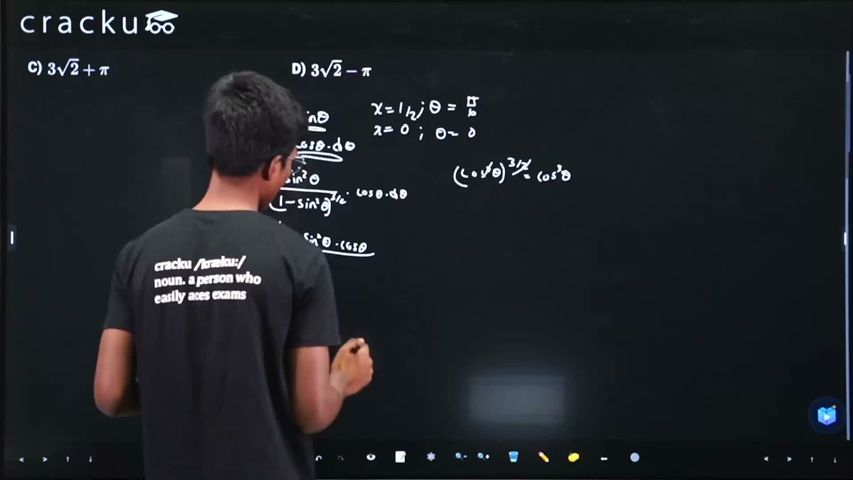
Because the denominator contains the term $$(1-x^{2})^{\frac32}$$, it is natural to make the trigonometric substitution that turns $$1-x^{2}$$ into a square of a cosine. So we let $$x=\sin\theta.$$
Under this substitution we have the following relations:
$$x=\sin\theta \; \Longrightarrow \; dx=\cos\theta\,d\theta,$$
$$1-x^{2}=1-\sin^{2}\theta=\cos^{2}\theta,$$
$$\left(1-x^{2}\right)^{\frac32}=\left(\cos^{2}\theta\right)^{\frac32}=\cos^{3}\theta.$$
Next we change the limits of integration. When $$x=0,$$ we get $$\sin\theta=0 \Longrightarrow \theta=0.$$ When $$x=\dfrac12,$$ we get $$\sin\theta=\dfrac12 \Longrightarrow \theta=\arcsin\!\left(\dfrac12\right)=\dfrac{\pi}{6}.$$ Thus the integral becomes
$$\int_{0}^{\frac12}\frac{x^{2}}{(1-x^{2})^{\frac32}}\,dx \;=\;\int_{0}^{\frac{\pi}{6}}\frac{\sin^{2}\theta}{\cos^{3}\theta}\,\cos\theta\,d\theta.$$
We simplify the integrand step by step. The factor $$\cos\theta$$ coming from $$dx$$ cancels one power of $$\cos\theta$$ in the denominator:
$$\frac{\sin^{2}\theta}{\cos^{3}\theta}\,\cos\theta=\frac{\sin^{2}\theta}{\cos^{2}\theta}=\tan^{2}\theta.$$
So the integral now is
$$I=\int_{0}^{\frac{\pi}{6}}\tan^{2}\theta\,d\theta.$$
To integrate $$\tan^{2}\theta$$ we use the standard identity $$\tan^{2}\theta=\sec^{2}\theta-1.$$ Substituting this identity we get
$$I=\int_{0}^{\frac{\pi}{6}}\left(\sec^{2}\theta-1\right)\,d\theta.$$
We integrate term by term. The antiderivative of $$\sec^{2}\theta$$ is $$\tan\theta,$$ and the antiderivative of $$1$$ is $$\theta.$$ Therefore
$$I=\Bigl[\tan\theta-\theta\Bigr]_{0}^{\frac{\pi}{6}}.$$
Now we substitute the limits. At $$\theta=\dfrac{\pi}{6}$$ we have $$\tan\!\left(\dfrac{\pi}{6}\right)=\dfrac{1}{\sqrt3},$$ and at $$\theta=0$$ we have $$\tan 0 =0.$$ Hence
$$I=\left(\dfrac{1}{\sqrt3}-\dfrac{\pi}{6}\right)-\left(0-0\right)=\dfrac{1}{\sqrt3}-\dfrac{\pi}{6}.$$
The problem statement tells us that this value equals $$\dfrac{k}{6}.$$ Equating the two expressions gives
$$\dfrac{1}{\sqrt3}-\dfrac{\pi}{6}=\dfrac{k}{6}.$$
We isolate $$k$$ by multiplying both sides by $$6$$:
$$6\left(\dfrac{1}{\sqrt3}-\dfrac{\pi}{6}\right)=k.$$
Simplifying the left-hand side step by step, first distribute the 6:
$$\dfrac{6}{\sqrt3}-\pi=k.$$
We simplify $$\dfrac{6}{\sqrt3}$$ by rationalising the denominator:
$$\dfrac{6}{\sqrt3}=\dfrac{6\sqrt3}{3}=2\sqrt3.$$
So we finally get
$$k=2\sqrt3-\pi.$$
Among the given options we look for $$2\sqrt3-\pi,$$ which appears as Option B.
Hence, the correct answer is Option B.
Was this solution helpful?
Click on the Email ☝️ to Watch the Video Solution
Create a FREE account and get:
_1.webp)

Educational materials for JEE preparation

Ask our AI anything

AI can make mistakes. Please verify important information.
AI can make mistakes. Please verify important information.
