
Join Our JEE Preparation Group
Prep with like-minded aspirants; Get access to free daily tests and study material.
Sign in
Please select an account to continue using cracku.in
↓ →
Join Our JEE Preparation Group
Prep with like-minded aspirants; Get access to free daily tests and study material.
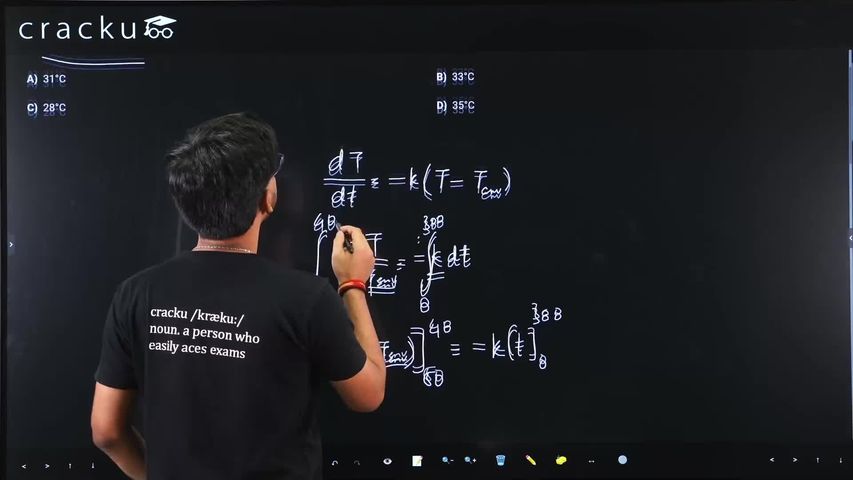
A metallic sphere cools from 50°C to 40°C in 300 s. If atmospheric temperature around is 20°C, then the sphere's temperature after the next 5 minutes will be close to:
We begin with Newton’s law of cooling, which says that the rate of fall of temperature of a body is directly proportional to the difference between its temperature and the temperature of the surroundings. In equation form, the law is written as
$$\frac{dT}{dt} = -k\,\bigl(T - T_{\text{env}}\bigr),$$
where $$T$$ is the instantaneous temperature of the body, $$T_{\text{env}}$$ is the constant atmospheric (environment) temperature, and $$k$$ is a positive proportionality constant that depends on the nature of the body and its surroundings.
Integrating this differential equation gives the standard exponential cooling formula
$$T - T_{\text{env}} = \bigl(T_0 - T_{\text{env}}\bigr)\,e^{-kt},$$
in which $$T_0$$ is the initial temperature at time $$t = 0$$.
We are told that the metallic sphere has an initial temperature $$T_1 = 50^\circ\text{C}$$ and cools to $$T_2 = 40^\circ\text{C}$$ in $$t_1 = 300\ \text{s}$$ (that is, 5 minutes). The atmospheric temperature is
$$T_{\text{env}} = 20^\circ\text{C}.$$
Substituting these values into the exponential form for the first cooling interval, we write
$$T_2 - T_{\text{env}} = \bigl(T_1 - T_{\text{env}}\bigr)\,e^{-k t_1}.$$
So, using the numbers,
$$40 - 20 = (50 - 20)\,e^{-k \times 300}.$$
Simplifying the numerical differences gives
$$20 = 30\,e^{-300k}.$$
To isolate the exponential factor, we divide both sides by 30:
$$\frac{20}{30} = e^{-300k}.$$
So,
$$\frac{2}{3} = e^{-300k}.$$
Now we take the natural logarithm on both sides to solve for $$k$$:
$$\ln\!\bigl(\tfrac{2}{3}\bigr) = -300k.$$
Hence,
$$k = -\frac{1}{300}\,\ln\!\bigl(\tfrac{2}{3}\bigr) = \frac{1}{300}\,\ln\!\bigl(\tfrac{3}{2}\bigr).$$
With the value of $$k$$ fixed, we now want the temperature $$T_3$$ of the sphere after a further time of another 5 minutes, that is, after a second interval of $$t_2 = 300\ \text{s}$$. The total time elapsed from the initial instant will then be $$t_{\text{total}} = 600\ \text{s}$$.
Using the exponential law again for the whole 600-second span, we have
$$T_3 - T_{\text{env}} = \bigl(T_1 - T_{\text{env}}\bigr)\,e^{-k t_{\text{total}}}.$$
That is,
$$T_3 - 20 = 30 \, e^{-k \times 600}.$$
Because $$e^{-k \times 600} = \bigl(e^{-k \times 300}\bigr)^{2},$$ and from earlier we already found $$e^{-k \times 300} = \tfrac{2}{3},$$ we can write
$$e^{-k \times 600} = \left(\tfrac{2}{3}\right)^{2} = \tfrac{4}{9}.$$
Substituting this value back gives
$$T_3 - 20 = 30 \times \frac{4}{9}.$$
Carrying out the multiplication,
$$T_3 - 20 = \frac{120}{9} = 13.\overline{3}\;^\circ\text{C}.$$
Finally, adding 20°C to both sides yields
$$T_3 = 20 + 13.\overline{3} \approx 33.3^\circ\text{C}.$$
The temperature after the next five minutes is therefore very close to $$33^\circ\text{C}$$, matching option B.
Hence, the correct answer is Option B.
Was this solution helpful?
Click on the Email ☝️ to Watch the Video Solution
Create a FREE account and get:
_1.webp)

Educational materials for JEE preparation

Ask our AI anything

AI can make mistakes. Please verify important information.
AI can make mistakes. Please verify important information.
