
Join Our JEE Preparation Group
Prep with like-minded aspirants; Get access to free daily tests and study material.
Sign in
Please select an account to continue using cracku.in
↓ →
Join Our JEE Preparation Group
Prep with like-minded aspirants; Get access to free daily tests and study material.
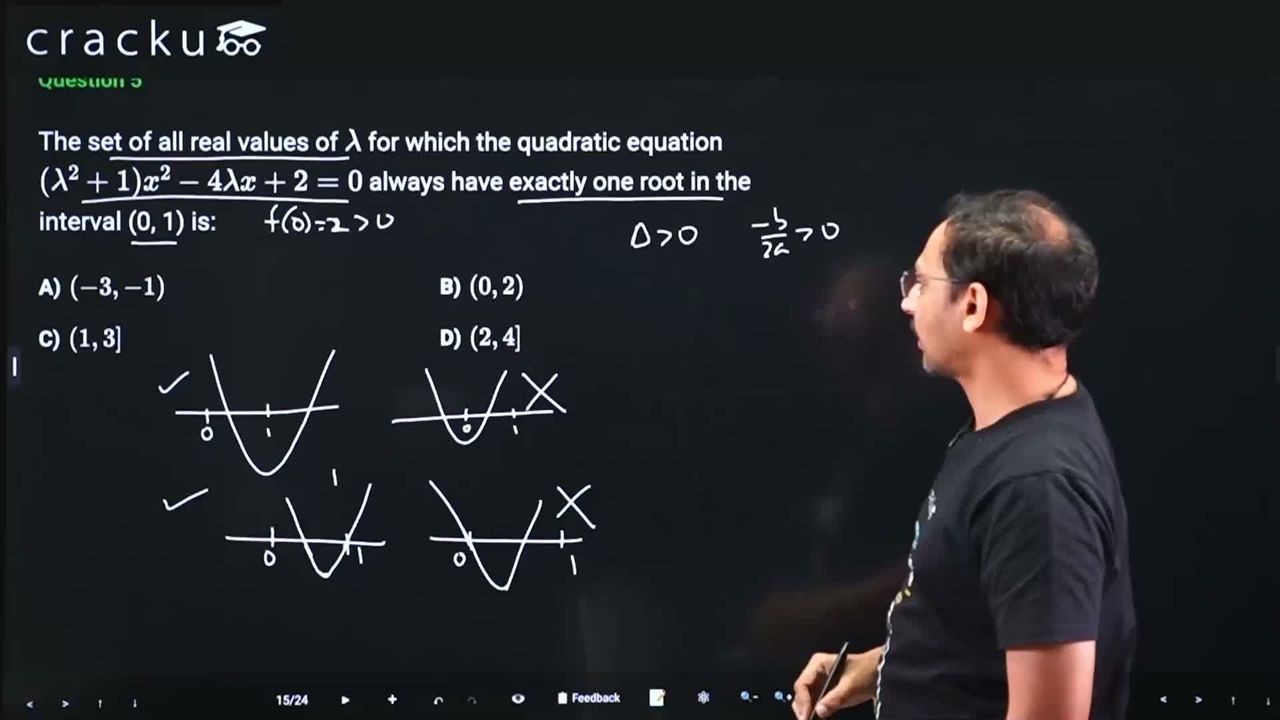
The set of all real values of $$\lambda$$ for which the quadratic equation $$(\lambda^2 + 1)x^2 - 4\lambda x + 2 = 0$$ always have exactly one root in the interval (0, 1) is:
Let us denote the given quadratic by
$$f(x)=(\lambda^{2}+1)\,x^{2}-4\lambda\,x+2.$$
Since $$\lambda^{2}+1\gt 0$$ for every real $$\lambda$$, the parabola $$y=f(x)$$ always opens upward.
To be able to talk about the location of its roots we first ensure that real roots exist. For a quadratic $$ax^{2}+bx+c=0$$ the condition for real roots is given by the discriminant formula
$$\Delta=b^{2}-4ac\ge 0.$$
Here $$a=\lambda^{2}+1,\;b=-4\lambda,\;c=2,$$ so
$$\Delta=(-4\lambda)^{2}-4(\lambda^{2}+1)(2)=16\lambda^{2}-8(\lambda^{2}+1)=8\lambda^{2}-8=8(\lambda^{2}-1).$$
Thus
$$\Delta\ge 0\iff 8(\lambda^{2}-1)\ge 0\iff \lambda^{2}-1\ge 0\iff |\lambda|\ge 1.$$
Hence, if $$|\lambda|\lt 1$$ the equation has no real root at all, so no value of $$\lambda$$ from that part can be accepted. From now on we restrict ourselves to
$$|\lambda|\ge 1.$$
We want the quadratic to have exactly one root in the open interval $$(0,1).$$ Because the parabola opens upward, a convenient way to count the crossings of the $$x$$-axis inside $$(0,1)$$ is to look at the signs of $$f(x)$$ at the end-points of the interval and make use of the Intermediate Value Theorem.
At $$x=0$$ we have
$$f(0)=2,$$
which is always positive.
At $$x=1$$ we have
$$f(1)=(\lambda^{2}+1)\cdot 1^{2}-4\lambda\cdot 1+2=\lambda^{2}-4\lambda+3.$$
Factoring the quadratic in $$\lambda$$ gives
$$f(1)=\lambda^{2}-4\lambda+3=(\lambda-1)(\lambda-3).$$
Now we examine the sign of $$f(1).$$
• If $$1\lt \lambda\lt 3,$$ then $$\lambda-1\gt 0$$ and $$\lambda-3\lt 0,$$ so
$$f(1)\lt 0.$$
• If $$\lambda=1$$ or $$\lambda=3,$$ then $$f(1)=0.$$
• If $$\lambda\lt 1$$ or $$\lambda\gt 3,$$ then both factors have the same sign, hence
$$f(1)\gt 0.$$
Because $$f(0)\gt 0$$ always, the only way to obtain exactly one sign change (and therefore exactly one root) between $$x=0$$ and $$x=1$$ is to have
$$f(1)\lt 0.$$
Indeed, when $$f(1)\lt 0$$ the function is positive at $$x=0$$ and negative at $$x=1$$, so it must cross the $$x$$-axis precisely once within the open interval $$(0,1)$$. After that single crossing the graph eventually rises again (because the parabola opens upward) and meets the $$x$$-axis a second time at some $$x\gt 1$$, giving the total of two real roots with exactly one of them lying inside $$(0,1).$$
Therefore the required condition is
$$f(1)\lt 0\quad\Longleftrightarrow\quad (\lambda-1)(\lambda-3)\lt 0\quad\Longleftrightarrow\quad 1\lt \lambda\lt 3.$$
We still need to check the boundary points:
• For $$\lambda=1$$ we get $$f(1)=0$$ and the quadratic becomes $$2(x-1)^{2}=0,$$ whose double root is $$x=1,$$ lying outside the open interval $$(0,1)$$. Hence no root lies in $$(0,1)$$ — this value is excluded.
• For $$\lambda=3$$ we get one root at $$x=1$$ and the other at $$x=\dfrac15,$$ so exactly one root is in $$(0,1).$$ Thus $$\lambda=3$$ is admissible.
Combining everything, the set of all real $$\lambda$$ for which the quadratic has exactly one root in the interval $$(0,1)$$ is
$$(1,3].$$
Among the given options this matches Option C.
Hence, the correct answer is Option C.
Was this solution helpful?
Click on the Email ☝️ to Watch the Video Solution
Create a FREE account and get:
_1.webp)

Educational materials for JEE preparation

Ask our AI anything

AI can make mistakes. Please verify important information.
AI can make mistakes. Please verify important information.
