
Join Our JEE Preparation Group
Prep with like-minded aspirants; Get access to free daily tests and study material.
Sign in
Please select an account to continue using cracku.in
↓ →
Join Our JEE Preparation Group
Prep with like-minded aspirants; Get access to free daily tests and study material.
A particle is moving unidirectional on a horizontal plane under the action of a constant power supplying energy source. The displacement (s) - time (t) graph that describes the motion of the particle is (graphs are drawn schematically and are not to scale):
$$P = F \cdot v = \text{constant}$$
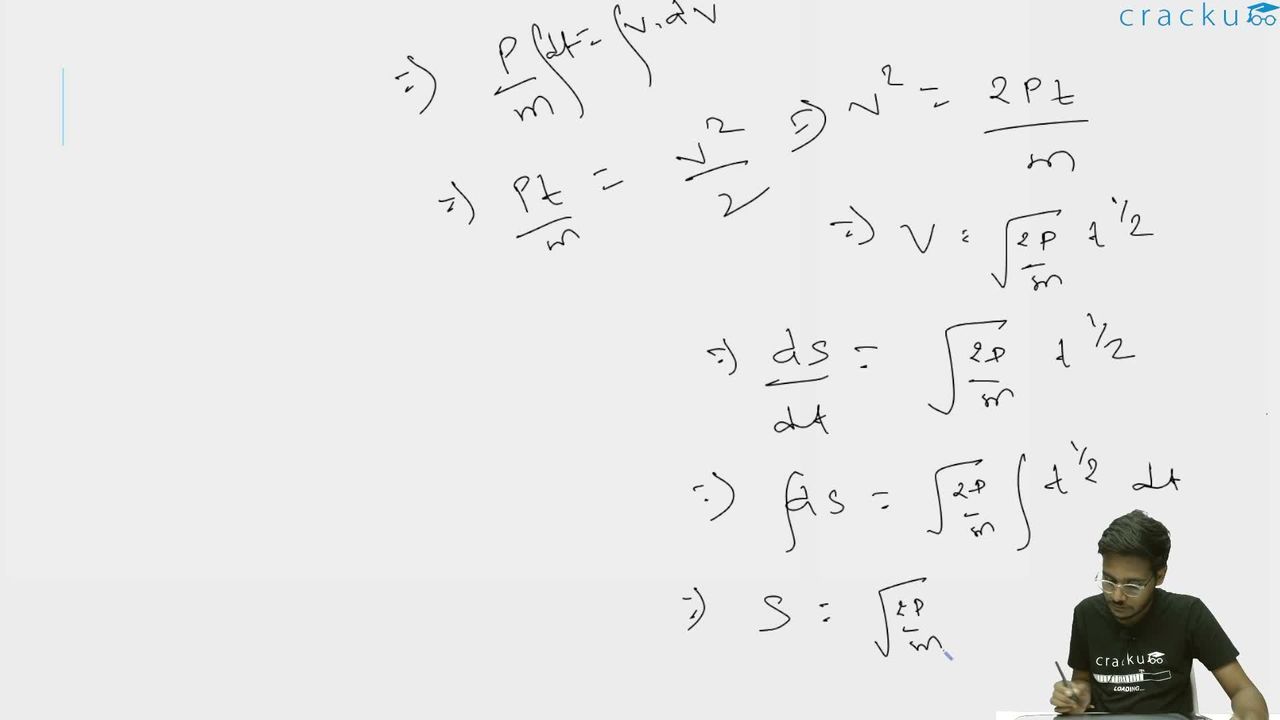
$$m \frac{dv}{dt} \cdot v = P \implies v \, dv = \frac{P}{m} \, dt$$
$$\int_0^v v \, dv = \int_0^t \frac{P}{m} \, dt \implies \frac{v^2}{2} = \frac{P}{m} t \implies v = \sqrt{\frac{2P}{m}} t^{1/2}$$
$$\frac{ds}{dt} = \sqrt{\frac{2P}{m}} t^{1/2} \implies ds = \sqrt{\frac{2P}{m}} t^{1/2} \, dt$$
$$s = \int_0^t \sqrt{\frac{2P}{m}} t^{1/2} \, dt = \sqrt{\frac{2P}{m}} \left(\frac{2}{3} t^{3/2}\right) \implies s \propto t^{3/2}$$
Since the exponent of $$t$$ is greater than $$1$$, the slope $$\frac{ds}{dt}$$ increases with time, representing a parabolic-like curve that is concave upwards.
Was this solution helpful?
Click on the Email ☝️ to Watch the Video Solution
Create a FREE account and get:
_1.webp)

Educational materials for JEE preparation

Ask our AI anything

AI can make mistakes. Please verify important information.
AI can make mistakes. Please verify important information.
