
Join Our JEE Preparation Group
Prep with like-minded aspirants; Get access to free daily tests and study material.
Sign in
Please select an account to continue using cracku.in
↓ →
Join Our JEE Preparation Group
Prep with like-minded aspirants; Get access to free daily tests and study material.
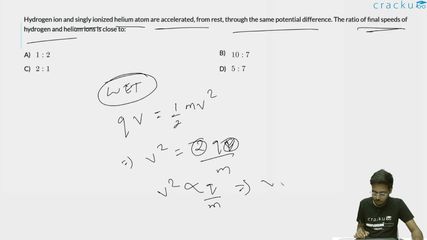
Hydrogen ion and singly ionized helium atom are accelerated, from rest, through the same potential difference. The ratio of final speeds of hydrogen and helium ions is close to:
We begin by recalling the energy principle for a charged particle moving through an electric potential difference. The work done by the electric field is converted into kinetic energy. Mathematically we state the relation
$$\text{Work done} \;=\; qV \;=\; \tfrac12 m v^{2},$$
where $$q$$ is the charge on the particle, $$V$$ is the potential difference, $$m$$ is the mass of the particle and $$v$$ is the final speed acquired from rest.
We now apply this relation separately to the hydrogen ion (proton) and to the singly ionised helium atom.
For the hydrogen ion (symbolically $$\text{H}^{+}$$):
Its charge is that of one proton, so $$q_{\text{H}} = +e$$. We denote its mass by $$m_{\text{H}}$$. Substituting these into the energy equation we have
$$q_{\text{H}} V = \tfrac12 m_{\text{H}} v_{\text{H}}^{2}.$$
Explicitly, that reads
$$e\,V = \tfrac12\,m_{\text{H}}\,v_{\text{H}}^{2}.$$
Solving for the speed $$v_{\text{H}}$$ gives
$$v_{\text{H}}^{2} = \frac{2eV}{m_{\text{H}}}, \qquad\text{so}\qquad v_{\text{H}} = \sqrt{\frac{2eV}{m_{\text{H}}}}.$$
For the singly ionised helium atom (symbolically $$\text{He}^{+}$$):
Although the helium nucleus contains two protons, the phrase “singly ionised” means it has lost only one electron, so its net charge is still just one elementary charge. Hence
$$q_{\text{He}} = +e.$$
The mass of a helium nucleus is essentially four times the proton mass, so we write
$$m_{\text{He}} = 4\,m_{\text{H}}.$$
Inserting these values into the same energy equation gives
$$q_{\text{He}} V = \tfrac12 m_{\text{He}} v_{\text{He}}^{2}$$
$$e\,V = \tfrac12 \left(4m_{\text{H}}\right) v_{\text{He}}^{2}.$$
Rearranging to isolate $$v_{\text{He}}^{2}$$:
$$v_{\text{He}}^{2} = \frac{2eV}{4m_{\text{H}}} = \frac{1}{4}\,\frac{2eV}{m_{\text{H}}},$$
and therefore
$$v_{\text{He}} = \sqrt{\frac{1}{4}\,\frac{2eV}{m_{\text{H}}}} = \frac{1}{2}\,\sqrt{\frac{2eV}{m_{\text{H}}}}.$$
Computing the ratio of the two speeds:
$$\frac{v_{\text{H}}}{v_{\text{He}}} = \frac{\sqrt{\dfrac{2eV}{m_{\text{H}}}}} {\dfrac{1}{2}\sqrt{\dfrac{2eV}{m_{\text{H}}}}} = \frac{\sqrt{\dfrac{2eV}{m_{\text{H}}}}}{\sqrt{\dfrac{2eV}{m_{\text{H}}}}/2} = 2.$$
Thus,
$$v_{\text{H}} : v_{\text{He}} = 2 : 1.$$
Hence, the correct answer is Option C.
Was this solution helpful?
Click on the Email ☝️ to Watch the Video Solution
Create a FREE account and get:
_1.webp)

Educational materials for JEE preparation

Ask our AI anything

AI can make mistakes. Please verify important information.
AI can make mistakes. Please verify important information.
