
Join Our JEE Preparation Group
Prep with like-minded aspirants; Get access to free daily tests and study material.
Sign in
Please select an account to continue using cracku.in
↓ →
Join Our JEE Preparation Group
Prep with like-minded aspirants; Get access to free daily tests and study material.
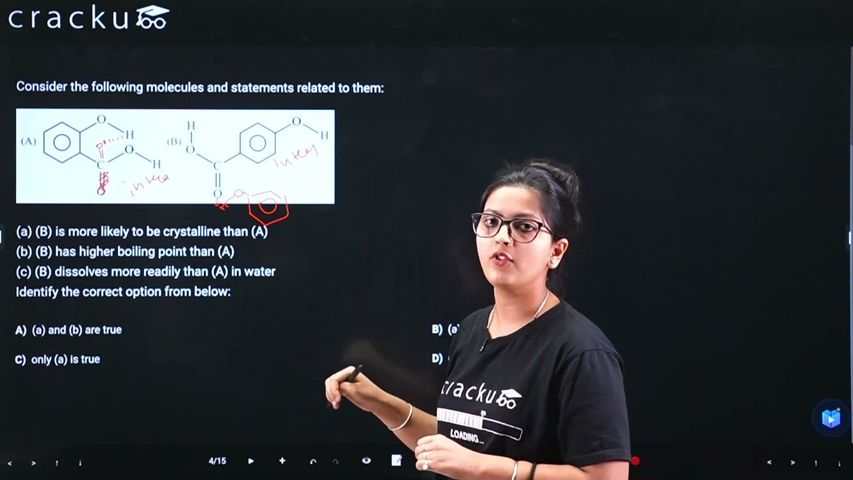
Consider the following molecules and statements related to them:
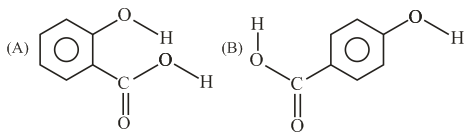
(a) (B) is more likely to be crystalline than (A)
(b) (B) has higher boiling point than (A)
(c) (B) dissolves more readily than (A) in water
Identify the correct option from below:
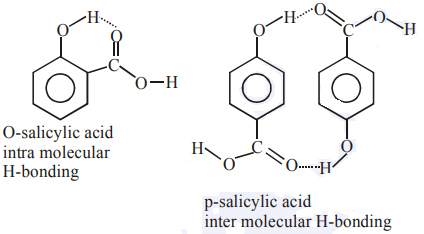
Compound A (o-salicylic acid / 2-hydroxybenzoic acid):
In the ortho-isomer, the hydroxyl group ($$\text{--OH}$$) and the carboxylic acid group ($$\text{--COOH}$$) are positioned adjacent to each other. This spatial proximity allows for the formation of stable, cyclic intramolecular hydrogen bonding (hydrogen bonding within the same molecule).
Compound B (p-salicylic acid / 4-hydroxybenzoic acid):
In the para-isomer, the functional groups are far apart at opposite ends of the benzene ring, making intramolecular hydrogen bonding sterically impossible. Instead, it forms extensive network-like intermolecular hydrogen bonding with neighboring molecules, effectively binding them together into large molecular aggregates.
Statement (a): (B) is more likely to be crystalline than (A)
Because of extensive intermolecular hydrogen bonding, the molecules of the para-isomer (B) pack more symmetrically, tightly, and effectively into a regular crystal lattice structure compared to the individual, discrete molecules of the ortho-isomer (A) But question does not provide structural evidence. Thus, (B) is more likely to be crystalline than (A) (False).
Statement (b): (B) has a higher boiling point than (A)
Intermolecular hydrogen bonding significantly increases intermolecular attractions, requiring much higher thermal energy to break the associations between molecules during a phase change. Intramolecular hydrogen bonding in (A) decreases its tendency to associate with neighboring molecules, making it more volatile. Thus, (B) has a higher boiling point than (A) (True).
Statement (c): (B) dissolves more readily than (A) in water
The para-isomer (B) can freely extend and form strong hydrogen bonds with external water molecules. Conversely, in the ortho-isomer (A), the functional groups are already internally engaged in chelation, making them less available to interact with water. Therefore, (B) dissolves more readily than (A) in water (True).
All three statements—(a), (b), and (c)—accurately describe the logical consequences of intermolecular versus intramolecular hydrogen bonding in these positions.
Answer: (b) and (c) are true
Was this solution helpful?
Click on the Email ☝️ to Watch the Video Solution
Create a FREE account and get:
_1.webp)

Educational materials for JEE preparation

Ask our AI anything

AI can make mistakes. Please verify important information.
AI can make mistakes. Please verify important information.
