
Join Our JEE Preparation Group
Prep with like-minded aspirants; Get access to free daily tests and study material.
Sign in
Please select an account to continue using cracku.in
↓ →
Join Our JEE Preparation Group
Prep with like-minded aspirants; Get access to free daily tests and study material.
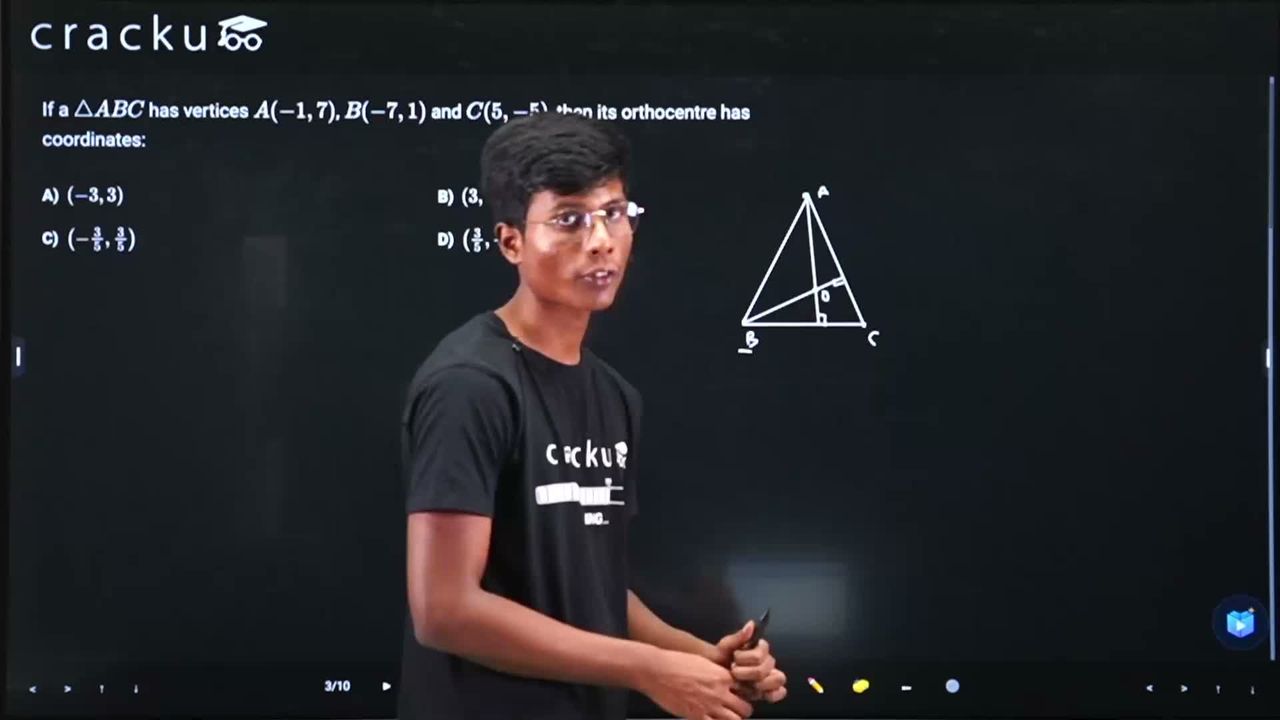
If a $$\triangle ABC$$ has vertices $$A(-1, 7)$$, $$B(-7, 1)$$ and $$C(5, -5)$$, then its orthocentre has coordinates:
First we list the coordinates of the three vertices of the triangle:
$$A(-1,\;7), \qquad B(-7,\;1), \qquad C(5,\;-5).$$
The orthocentre is the common point of the three altitudes. An altitude is a line drawn from one vertex and perpendicular to the opposite side. We shall find two such altitudes and then compute their intersection; that point will automatically be the orthocentre.
Altitude from vertex A
We first need the slope of side $$BC$$. Using the slope formula $$m=\dfrac{y_2-y_1}{x_2-x_1}$$, we have
$$m_{BC}=\dfrac{-5-1}{\,5-(-7)\,}=\dfrac{-6}{12}=-\dfrac12.$$
An altitude from $$A$$ is perpendicular to $$BC$$. For two perpendicular lines the product of their slopes is $$-1$$, that is
$$m_{BC}\;m_{\perp}=-1.$$
Substituting $$m_{BC}=-\dfrac12$$, we get
$$\Bigl(-\dfrac12\Bigr)\,m_{\perp}=-1 \;\Rightarrow\; m_{\perp}=2.$$
The altitude through $$A(-1,7)$$ therefore has slope $$2$$ and its equation (point-slope form $$y-y_1=m(x-x_1)$$) is
$$y-7=2\,(x+1).$$
Simplifying,
$$y-7=2x+2 \;\Longrightarrow\; y=2x+9.$$
Altitude from vertex B
Next we need the slope of side $$AC$$:
$$m_{AC}=\dfrac{-5-7}{\,5-(-1)\,}=\dfrac{-12}{6}=-2.$$
The altitude from $$B$$ is perpendicular to $$AC$$, so using $$m_{AC}\,m_{\perp}=-1$$ we get
$$(-2)\,m_{\perp}=-1 \;\Rightarrow\; m_{\perp}=\dfrac12.$$
This altitude passes through $$B(-7,1)$$ and has slope $$\dfrac12$$, giving
$$y-1=\dfrac12\,(x+7).$$
Simplifying,
$$y-1=\dfrac12x+\dfrac72 \;\Longrightarrow\; y=\dfrac12x+\dfrac72+1=\dfrac12x+\dfrac92.$$
Writing the constant in decimal for convenience, $$\dfrac92=4.5$$, so
$$y=\dfrac12x+4.5.$$
Intersection of the two altitudes
The orthocentre is where the lines
$$y=2x+9 \qquad\text{and}\qquad y=\dfrac12x+4.5$$
meet. Equating their right-hand sides,
$$2x+9=\dfrac12x+4.5.$$
To eliminate the fraction, multiply every term by $$2$$:
$$4x+18 = x+9.$$
Now bring all terms in $$x$$ to one side and constants to the other:
$$4x - x = 9 - 18 \;\Longrightarrow\; 3x = -9.$$
Dividing by $$3$$ gives
$$x = -3.$$
Substituting $$x=-3$$ into either altitude equation, say $$y=2x+9$$, we obtain
$$y = 2(-3)+9 = -6+9 = 3.$$
Thus the coordinates of the orthocentre are
$$(-3,\;3).$$
Comparing with the given options, this matches option A.
Hence, the correct answer is Option A.
Was this solution helpful?
Click on the Email ☝️ to Watch the Video Solution
Create a FREE account and get:
_1.webp)

Educational materials for JEE preparation

Ask our AI anything

AI can make mistakes. Please verify important information.
AI can make mistakes. Please verify important information.
