
Join Our JEE Preparation Group
Prep with like-minded aspirants; Get access to free daily tests and study material.
Sign in
Please select an account to continue using cracku.in
↓ →
Join Our JEE Preparation Group
Prep with like-minded aspirants; Get access to free daily tests and study material.
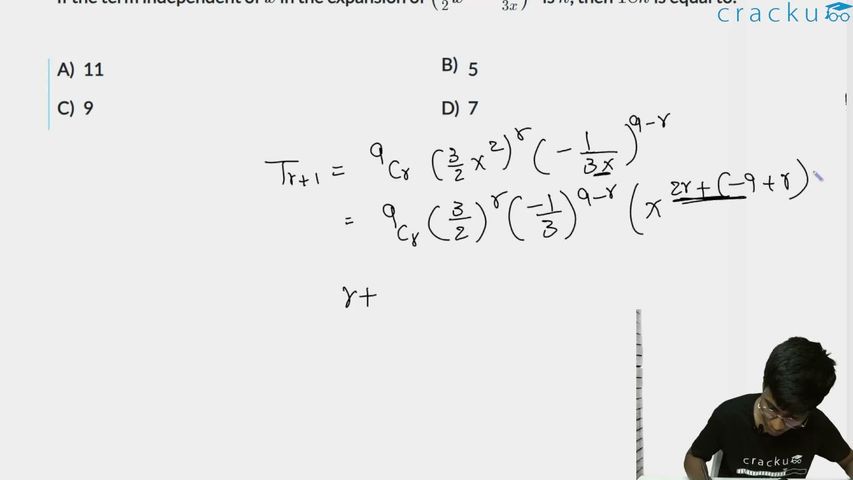
If the term independent of $$x$$ in the expansion of $$\left(\frac{3}{2}x^2 - \frac{1}{3x}\right)^9$$ is $$k$$, then $$18k$$ is equal to:
The expression to be expanded is $$\left(\dfrac{3}{2}x^{2}-\dfrac{1}{3x}\right)^{9}$$. We shall use the Binomial Theorem, which states that for any real numbers $$a$$, $$b$$ and a non-negative integer $$n$$, we have $$\displaystyle (a+b)^{n}=\sum_{r=0}^{n}{^{n}C_{r}}\,a^{\,n-r}\,b^{\,r}$$, where $${^{n}C_{r}}=\dfrac{n!}{r!(n-r)!}$$.
Here we identify $$a=\dfrac{3}{2}x^{2}$$ and $$b=-\dfrac{1}{3x}$$, with $$n=9$$. The general term obtained from the expansion is therefore
$$T_{r}={^{9}C_{r}}\left(\dfrac{3}{2}x^{2}\right)^{9-r}\left(-\dfrac{1}{3x}\right)^{r},\qquad r=0,1,2,\dots,9.$$
First we examine the power of $$x$$ in this term. We have
$$\left(\dfrac{3}{2}x^{2}\right)^{9-r} \; \text{contributes } x^{\,2(9-r)},$$ $$\left(-\dfrac{1}{3x}\right)^{r} \; \text{contributes } x^{-\,r}.$$
Multiplying these powers, the total exponent of $$x$$ in $$T_{r}$$ becomes
$$2(9-r) - r \;=\;18 - 3r.$$
We need the term that is independent of $$x$$, so we set this exponent equal to zero:
$$18 - 3r = 0 \quad\Longrightarrow\quad r = 6.$$
Thus the required term is obtained when $$r=6$$. Substituting $$r=6$$ into the general term, we get
$$T_{6} = {^{9}C_{6}}\left(\dfrac{3}{2}x^{2}\right)^{9-6}\left(-\dfrac{1}{3x}\right)^{6}.$$
Simplifying each factor one by one:
$${^{9}C_{6}} = {^{9}C_{3}} = \dfrac{9\times8\times7}{3\times2\times1} = 84,$$ $$\left(\dfrac{3}{2}x^{2}\right)^{3} = \left(\dfrac{3}{2}\right)^{3}x^{6} = \dfrac{27}{8}x^{6},$$ $$\left(-\dfrac{1}{3x}\right)^{6} = (-1)^{6}\dfrac{1}{3^{6}}x^{-6} = \dfrac{1}{729}x^{-6}.$$
Multiplying these three pieces, the powers of $$x$$ cancel out ($$x^{6}\cdot x^{-6}=x^{0}=1$$), and the numerical coefficient becomes
$$k \;=\; 84 \times \dfrac{27}{8} \times \dfrac{1}{729}.$$
Notice that $$729 = 27 \times 27$$, so
$$\dfrac{27}{729} = \dfrac{1}{27}.$$
Therefore
$$k = 84 \times \dfrac{1}{8} \times \dfrac{1}{27} = 84 \times \dfrac{1}{216} = \dfrac{84}{216}.$$
Dividing numerator and denominator by $$12$$ gives
$$k = \dfrac{7}{18}.$$
Finally, we are asked for $$18k$$:
$$18k = 18 \times \dfrac{7}{18} = 7.$$
Hence, the correct answer is Option D.
Was this solution helpful?
Click on the Email ☝️ to Watch the Video Solution
Create a FREE account and get:
_1.webp)

Educational materials for JEE preparation

Ask our AI anything

AI can make mistakes. Please verify important information.
AI can make mistakes. Please verify important information.
