
Join Our JEE Preparation Group
Prep with like-minded aspirants; Get access to free daily tests and study material.
Sign in
Please select an account to continue using cracku.in
↓ →
Join Our JEE Preparation Group
Prep with like-minded aspirants; Get access to free daily tests and study material.
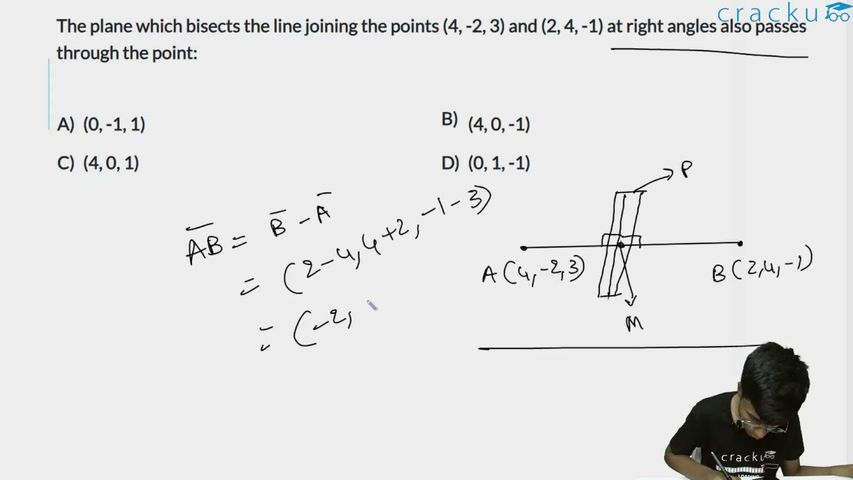
The plane which bisects the line joining the points (4, -2, 3) and (2, 4, -1) at right angles also passes through the point:
We have to find the equation of the plane that bisects the line segment joining the two given points $$A(4,\,-2,\,3)$$ and $$B(2,\,4,\,-1)$$ at right angles, and then check which option lies on that plane.
First, recall that a plane which is the perpendicular bisector of a segment must
$$$\text{(i) pass through the midpoint of the segment, and}$$$
$$$\text{(ii) have its normal vector parallel to the segment itself.}$$$
Let us determine each of these in turn.
Midpoint of the segment AB
The midpoint formula in 3-D is stated as: $$$ \text{Midpoint } M\;(x_m,y_m,z_m)=\left(\frac{x_1+x_2}{2},\,\frac{y_1+y_2}{2},\,\frac{z_1+z_2}{2}\right). $$$ Substituting the coordinates of $$A(4,-2,3)$$ and $$B(2,4,-1)$$, we get $$$ x_m=\frac{4+2}{2}=3,\qquad y_m=\frac{-2+4}{2}=1,\qquad z_m=\frac{3+(-1)}{2}=1. $$$ So the midpoint is $$ M(3,\,1,\,1). $$
Direction vector (and hence normal) of the segment AB
The vector $$\overrightarrow{AB}$$ is obtained by subtracting the coordinates of $$A$$ from $$B$$: $$$ \overrightarrow{AB} = (2-4,\;4-(-2),\;-1-3)=(-2,\;6,\;-4). $$$ Since the perpendicular bisector plane must be perpendicular to the segment, its normal vector can be taken as $$ \mathbf{n}=(-2,\,6,\,-4). $$
Equation of the required plane
The point-normal form of a plane is stated as: $$ \mathbf{n}\cdot\bigl(\mathbf{r}-\mathbf{r_0}\bigr)=0, $$ where $$\mathbf{n}$$ is the normal vector and $$\mathbf{r_0}$$ is the position vector of a point on the plane. Here, $$\mathbf{r_0}=M(3,1,1)$$ and $$\mathbf{n}=(-2,6,-4).$$ So we write $$$ (-2,\,6,\,-4)\cdot\bigl(x-3,\;y-1,\;z-1\bigr)=0. $$$ Carrying out the dot product term by term: $$ -2(x-3)+6(y-1)-4(z-1)=0. $$ Now expand each product: $$ -2x+6 + 6y-6 -4z+4 = 0. $$ Combine the constant terms $$6-6+4=4$$ to get $$ -2x + 6y - 4z + 4 = 0. $$ For simplicity, divide the entire equation by $$-2$$ (since $$-2\neq 0$$): $$ x - 3y + 2z - 2 = 0. $$ Hence the equation of the required plane is $$ x - 3y + 2z - 2 = 0. $$
Verifying which option lies on the plane
We substitute the coordinates of each option into the left-hand side of the plane equation $$x - 3y + 2z - 2.$$
Option A $$(0,\,-1,\,1):$$ $$$0 - 3(-1) + 2(1) - 2 = 0 + 3 + 2 - 2 = 3\neq 0.$$$
Option B $$(4,\,0,\,-1):$$ $$$4 - 3(0) + 2(-1) - 2 = 4 - 0 - 2 - 2 = 0.$$$
Option C $$(4,\,0,\,1):$$ $$$4 - 3(0) + 2(1) - 2 = 4 + 0 + 2 - 2 = 4\neq 0.$$$
Option D $$(0,\,1,\,-1):$$ $$$0 - 3(1) + 2(-1) - 2 = 0 - 3 - 2 - 2 = -7\neq 0.$$$
Only Option B makes the left-hand side zero, meaning that the point $$(4,\,0,\,-1)$$ satisfies the plane equation.
Hence, the correct answer is Option B.
Was this solution helpful?
Click on the Email ☝️ to Watch the Video Solution
Create a FREE account and get:
_1.webp)

Educational materials for JEE preparation

Ask our AI anything

AI can make mistakes. Please verify important information.
AI can make mistakes. Please verify important information.
