
Join Our JEE Preparation Group
Prep with like-minded aspirants; Get access to free daily tests and study material.
Sign in
Please select an account to continue using cracku.in
↓ →
Join Our JEE Preparation Group
Prep with like-minded aspirants; Get access to free daily tests and study material.
Consider the following reaction:
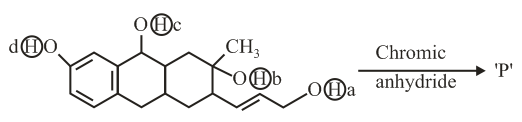
The product 'P' gives positive ceric ammonium nitrate test. This is because of the presence of which of these -OH group(s)?
The ceric ammonium nitrate (CAN) test is used to detect simple aliphatic alcohols. When an aliphatic -OH group is present, CAN is reduced, producing a crimson-red complex. In contrast, phenolic -OH groups (Ar-OH) and vinylic/enolic -OH groups do not form this coloured complex; hence they show a negative CAN test.
In product $$P$$ the -OH groups are labelled as (b), (c) and (d).
• -OH at position (b) is bonded to an sp3-hybridised carbon of a normal aliphatic (saturated) chain. Therefore it behaves as a regular alcohol and does give the crimson colour with ceric ammonium nitrate.
• -OH at position (c) is part of an enolic/vinylic system (attached to an sp2 carbon that is directly double-bonded). Such -OH groups do not produce the red complex with CAN.
• -OH at position (d) is a phenolic -OH (attached directly to an aromatic ring). Phenolic hydroxyl groups also fail to give a positive CAN test.
Hence, only the aliphatic alcohol (b) is responsible for the positive ceric ammonium nitrate test shown by product $$P$$.
Option A which is: (b) only
Was this solution helpful?
Create a FREE account and get:
_1.webp)

Educational materials for JEE preparation

Ask our AI anything

AI can make mistakes. Please verify important information.
AI can make mistakes. Please verify important information.
