
Join Our JEE Preparation Group
Prep with like-minded aspirants; Get access to free daily tests and study material.
Sign in
Please select an account to continue using cracku.in
↓ →
Join Our JEE Preparation Group
Prep with like-minded aspirants; Get access to free daily tests and study material.
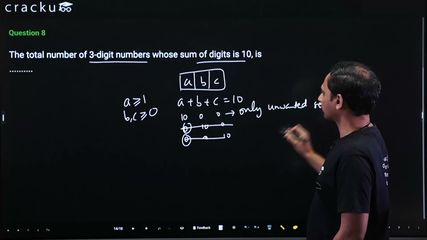
The total number of 3-digit numbers whose sum of digits is 10, is ..........
Correct Answer: 54
We are looking for all three-digit natural numbers. Such a number can be written in decimal form as $$\overline{abc}$$ where $$a$$ is the hundreds digit, $$b$$ is the tens digit and $$c$$ is the units digit.
Because the number is a three-digit number, the leading digit $$a$$ cannot be zero, so we must have $$1 \le a \le 9$$. The other two digits can be anything from $$0$$ to $$9$$, so $$0 \le b \le 9$$ and $$0 \le c \le 9$$.
We are told that the sum of the three digits equals $$10$$. Hence we need every integer solution of the linear equation
$$a + b + c = 10,$$
subject to
$$1 \le a \le 9,\quad 0 \le b \le 9,\quad 0 \le c \le 9.$$
To remove the lower bound on $$a$$, we make the substitution $$a' = a - 1$$. Because $$a$$ ranges from $$1$$ to $$9$$, the new variable $$a'$$ ranges from $$0$$ to $$8$$. In terms of $$a'$$, the equation becomes
$$\bigl(a' + 1\bigr) + b + c = 10.$$
Simplifying, we obtain
$$a' + b + c = 9,$$
with the simpler bounds
$$0 \le a' \le 8,\quad 0 \le b \le 9,\quad 0 \le c \le 9.$$
Now we must count the number of non-negative integer solutions of $$a' + b + c = 9$$ that also obey the upper limits $$a' \le 8,\; b \le 9,\; c \le 9$$. Observe that the total we seek is small enough that the natural upper limits $$b \le 9$$ and $$c \le 9$$ are automatically respected once the sum is only $$9$$, so the only possible overflow is $$a' = 9$$. Therefore we first count all non-negative solutions and then subtract the ones in which $$a' = 9$$ (because in that case $$a'$$ would exceed $$8$$).
The standard stars-and-bars result says: “The number of non-negative integer solutions of $$x_1 + x_2 + x_3 = n$$ is $$\binom{n+2}{2}$$.” We state it explicitly here before using it.
Applying the formula with $$n = 9$$ gives
$$\text{Total unrestricted solutions} \;=\; \binom{9+2}{2} = \binom{11}{2} = \frac{11 \times 10}{2} = 55.$$
Now we exclude the disallowed case $$a' = 9$$. Fixing $$a' = 9$$ forces $$b + c = 0,$$ so we must have $$b = 0$$ and $$c = 0$$. That is exactly one solution. No other violation is possible because if $$a'$$ were $$10$$ or more, the sum would exceed $$9$$.
Therefore the number of admissible solutions is
$$55 - 1 = 54.$$
Each admissible triple $$(a', b, c)$$ corresponds uniquely to $$a = a' + 1$$, so we have counted every valid three-digit number whose digits add to $$10$$.
So, the answer is $$54$$.
Was this solution helpful?
Click on the Email ☝️ to Watch the Video Solution
Create a FREE account and get:
_1.webp)

Educational materials for JEE preparation

Ask our AI anything

AI can make mistakes. Please verify important information.
AI can make mistakes. Please verify important information.
