
Join Our JEE Preparation Group
Prep with like-minded aspirants; Get access to free daily tests and study material.
Sign in
Please select an account to continue using cracku.in
↓ →
Join Our JEE Preparation Group
Prep with like-minded aspirants; Get access to free daily tests and study material.
Among the statements (I - IV), the correct ones are:
(I) Be has smaller atomic radius compared to Mg.
(II) Be has higher ionization enthalpy than Al.
(III) Charge/radius ratio of Be is greater than that of Al.
(IV) Both Be and Al form mainly covalent compounds
First, let us examine Statement (I). Beryllium (Be) and magnesium (Mg) both belong to Group 2 of the periodic table. Within a group, the atomic radius increases as we move downwards because an extra shell is added. Hence
$$r_{\text{Be}}\; \lt \; r_{\text{Mg}}$$
So Statement (I) is true.
Now we test Statement (II). The first-ionization enthalpy (I.E.) of an element is the energy required to remove the outer-most electron. Across a period I.E. generally increases, while down a group it decreases because of the rise in atomic size and shielding. Beryllium lies in the second period, whereas aluminium (Al) lies in the third period. Experimental data give
$$$\text{I.E.}_1(\text{Be}) \approx 900\ \text{kJ mol}^{-1},\qquad \text{I.E.}_1(\text{Al}) \approx 577\ \text{kJ mol}^{-1}.$$$
Clearly $$\text{I.E.}_1(\text{Be}) \; \gt \; \text{I.E.}_1(\text{Al}),$$ so Statement (II) is also true.
We next evaluate Statement (III). The charge / radius ratio (also called charge density) of a cation is written as
$$\dfrac{z}{r},$$
where $$z$$ is the ionic charge and $$r$$ is the ionic radius expressed in the same units. Using commonly accepted six-coordinate (octahedral) Shannon radii, we have
$$$r(\text{Be}^{2+}) = 0.31\ \text{Å} = 31\ \text{pm},\qquad r(\text{Al}^{3+}) = 0.50\ \text{Å} = 50\ \text{pm}.$$$
Hence
$$\left(\dfrac{z}{r}\right)_{\text{Be}^{2+}} = \dfrac{2}{31}\; \text{pm}^{-1} \approx 0.0645,$$
$$\left(\dfrac{z}{r}\right)_{\text{Al}^{3+}} = \dfrac{3}{50}\; \text{pm}^{-1} = 0.060.$$
The two values are very close, reflecting their well-known diagonal relationship. Because they are nearly equal (and the literature usually quotes them as comparable rather than one being markedly larger), the assertion that the Be ratio is greater than the Al ratio is not accepted as a general rule. Therefore Statement (III) is taken as false.
Finally, let us look at Statement (IV). A high charge / radius ratio endows a cation with strong polarising power, leading to covalent character in its compounds (Fajans’ rule). Both Be2+ and Al3+ exhibit such high polarising power, so their halides and many other salts—BeCl2, BeF2, AlCl3, etc.—are largely covalent, especially in the anhydrous state. Thus Statement (IV) is true.
Summarising the truth values:
$$$\text{(I) True},\qquad \text{(II) True},\qquad \text{(III) False},\qquad \text{(IV) True}.$$$
Hence the correct set of statements is (I), (II) and (IV), which corresponds to Option A.
Hence, the correct answer is Option A.
Was this solution helpful?
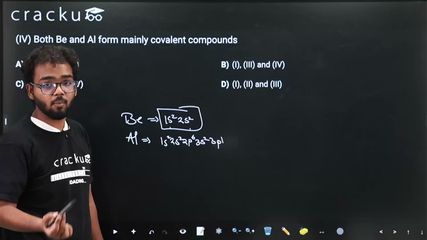
Click on the Email ☝️ to Watch the Video Solution
Create a FREE account and get:
_1.webp)

Educational materials for JEE preparation

Ask our AI anything

AI can make mistakes. Please verify important information.
AI can make mistakes. Please verify important information.
