JEE WhatsApp Group




JEE Magnetism & Magnetic Materials PYQs
JEE Magnetism & Magnetic Materials PYQs play an important role in building a strong understanding of magnetic fields, magnetic substances, and their behaviour. This chapter introduces concepts such as magnetic dipoles, bar magnets, Earth's magnetism, magnetic field lines, magnetic susceptibility, magnetic permeability, and different types of magnetic materials. Although the theory may seem straightforward, the questions often test how well you understand the underlying concepts.
Unlike chapters that involve lengthy calculations, Magnetism & Magnetic Materials focuses more on visualisation and conceptual thinking. You may be asked to compare different magnetic materials, analyse the behaviour of a magnetic dipole, or apply basic magnetic principles to unfamiliar situations. With regular practice, these questions become much easier to solve.
One of the best ways to prepare is by solving JEE Questions from this chapter on a regular basis. Doing so helps you recognise the important concepts, improves your confidence, and prepares you for the different styles of questions that can appear in the examination.
This page includes carefully selected previous-year questions, a Magnetism & Magnetic Materials Formula Sheet, important formulas for revision, common mistakes to avoid, and additional practice questions. It is designed to help you revise the entire chapter in one place before your next test.
JEE Magnetism & Magnetic Materials Important PYQs PDF
The PYQ PDF includes questions from the most important topics of this chapter. These may cover magnetic dipole moment, torque on a magnetic dipole, Earth's magnetic field, magnetic field lines, magnetic susceptibility, magnetic permeability, diamagnetic, paramagnetic, and ferromagnetic materials.
Practising these questions helps you understand how conceptual questions are framed in JEE. Many problems are based on simple ideas, but they require careful observation and the correct interpretation of the given information. Working through JEE Mains Previous Papers is also a great way to become familiar with the level of questions asked over the years.
Important Magnetism & Magnetic Materials Formula Sheet for JEE
Most questions from this chapter can be solved using a small set of well-known formulas. Instead of trying to remember every expression separately, focus on understanding where each formula is used and what each quantity represents.
You can download the complete Formula Sheet from the link above. It can also be added to your JEE Mains Formula Sheet so that all your important Physics formulas are available in one place during revision.
| Concept | Formula |
|---|---|
| Torque on a Magnetic Dipole | τ = MB sin θ |
| Potential Energy of a Dipole | U = −MB cos θ |
| Magnetic Dipole Moment | M = m(2l) |
| Magnetic Field on Axial Line | B = μ₀(2M)/4πr³ |
| Magnetic Field on Equatorial Line | B = μ₀M/4πr³ |
| Magnetic Susceptibility | χ = M/H |
| Magnetic Permeability | μ = B/H |
| Relative Permeability | μᵣ = μ/μ₀ |
| Intensity of Magnetisation | I = M/V |
| Relation Between B, H and M | B = μ₀(H + M) |
These formulas are commonly used in questions involving magnetic dipoles, Earth's magnetic field, and magnetic materials. Revising them with reliable JEE Study Material can make it easier to remember the important relationships during the exam.
Common Mistakes to Avoid in JEE Magnetism & Magnetic Materials PYQs
Most mistakes in this chapter happen because students confuse similar concepts rather than because the calculations are difficult.
Confusing magnetic field with magnetic field intensity
Magnetic field (B) and magnetic field intensity (H) are closely related, but they are different physical quantities. Make sure you know where each one is used.
Mixing up diamagnetic, paramagnetic, and ferromagnetic materials
These materials behave differently in the presence of a magnetic field. Understanding their basic properties is much more useful than trying to memorise a long list of examples.
Using the wrong dipole formula
The magnetic field on the axial line and the equatorial line of a magnetic dipole are not the same. Check the position of the observation point before applying any formula.
Ignoring the direction of torque
When solving dipole problems, many students calculate only the magnitude and forget to think about the direction in which the dipole tends to rotate.
Overlooking Earth's magnetic field concepts
Questions related to magnetic declination, inclination, and the horizontal component of Earth's magnetic field are often simple, but they are easy to answer incorrectly if the definitions are not clear.
Regular revision with JEE Magnetism & Magnetic Materials Questions and a JEE Mains Mock Test can help you identify these mistakes early and improve your confidence before the exam.
How to Prepare Magnetism & Magnetic Materials for JEE
This chapter becomes much easier when you study it concept by concept instead of trying to memorise everything at once. Begin with magnetic dipoles and magnetic fields, then move to Earth's magnetism, followed by magnetic properties of materials.
While practising, draw simple diagrams wherever possible. A quick sketch often makes it easier to understand the direction of the magnetic field or the orientation of a magnetic dipole. After revising the concepts, solve a few previous-year questions to check whether you can apply them correctly without looking at the formulas.
List of JEE Magnetism & Magnetic Materials PYQs
Below is a test-style set of questions based on magnetic dipoles, Earth's magnetism, magnetic field lines, susceptibility, permeability, and magnetic materials. Try to solve each question on your own before checking the answer.
Question 1
In a uniform magnetic field, the magnetic needle has a magnetic moment $$9.85 \times 10^{-2}$$ A m$$^{-2}$$ and moment of inertia $$5 \times 10^{-6}$$ kg m$$^2$$. If it performs 10 complete oscillations in 5 seconds then the magnitude of the magnetic field is _________ mT [Take $$\pi^2$$ as 9.85]
correct answer:- 8
Question 2
An electron and a proton having the same kinetic energy enter a region of uniform magnetic field $$B$$ acting perpendicular to their velocity vectors. Let $$r_e$$ and $$r_p$$ be the radii of their circular paths respectively. If the mass of the proton is approximately $$1800$$ times the mass of the electron ($$m_p \approx 1800 \, m_e$$), the ratio of their radii $$\frac{r_p}{r_e}$$ is:
correct answer:- 30
Question 3
The magnetic field of earth at the equator is approximately $$4 \times 10^{-5}$$ T. The radius of earth is $$6.4 \times 10^6$$ m. Then the dipole moment of the earth will be nearly of the order of:
correct answer:- 4
Question 4
A magnetic compass needle oscillates 30 times per minute at a place where the dip is 45° and 40 times per minute where the dip is 30°. If B$$_1$$ and B$$_2$$ are the net magnetic fields due to the earth at the two places respectively, then the ratio B$$_1$$/B$$_2$$ is approximately equal to
correct answer:- 4
Question 5
A paramagnetic substance in the form of a cube with sides 1 cm has a magnetic dipole moment of $$20 \times 10^{-6}$$ J/T when a magnetic intensity of $$60 \times 10^3$$ A/m is applied. Its magnetic susceptibility is:
correct answer:- 4

Question 6
The value of aluminium susceptibility is $$2.2 \times 10^{-5}$$. The percentage increase in the magnetic field if space within a current carrying toroid is filled with aluminium is $$\frac{x}{10^4}$$. Then the value of $$x$$ is ___.
correct answer:- 22
Question 7
An iron rod of volume $$10^{-3}\,\text{m}^3$$ and relative permeability 1000 is placed as core in a solenoid with 10 turns $$\text{cm}^{-1}$$. If a current of $$0.5\,\text{A}$$ is passed through the solenoid, then the magnetic moment of the rod will be:
correct answer:- 2
Question 8
The vertical component of the earth's magnetic field is $$6 \times 10^{-5}$$ T at any place where the angle of dip is 37°. The earth's resultant magnetic field at that place will be (Given tan 37° = 3/4)
correct answer:- 4
Question 9
In a ferromagnetic material, below the curie temperature, a domain is defined as:
correct answer:- 1
Question 10
At an angle of 30$$^\circ$$ to the magnetic meridian, the apparent dip is 45$$^\circ$$. Find the true dip:
correct answer:- 4

Question 11
Two bar magnets oscillate in a horizontal plane in earth's magnetic field with time periods of $$3 \text{ s}$$ and $$4 \text{ s}$$ respectively. If their moments of inertia are in the ratio of $$3:2$$ then the ratio of their magnetic moments will be
correct answer:- 2
Question 12
At a certain place the angle of dip is 30° and the horizontal component of earth's magnetic field is 0.5 G. The earth's total magnetic field (in G), at that certain place, is
correct answer:- 1
Question 13
The space inside a straight current carrying solenoid is filled with a magnetic material having magnetic susceptibility equal to $$1.2 \times 10^{-5}$$. What is fractional increase in the magnetic field inside solenoid with respect to air as medium inside the solenoid?
correct answer:- 1
Question 14
The coercivity of a magnet is $$5 \times 10^3$$ A/m. The amount of current required to be passed in a solenoid of length 30 cm and the number of turns 150, so that the magnet gets demagnetised when inside the solenoid is _____ A.
correct answer:- 10
Question 15
A coil of 200 turns and area $$0.20 \text{ m}^2$$ is rotated at half a revolution per second and is placed in uniform magnetic field of 0.01 T perpendicular to axis of rotation of the coil. The maximum voltage generated in the coil is $$\frac{2\pi}{\beta}$$ volt. The value of $$\beta$$ is ______.
correct answer:- 5

Question 16
In Young's double slit experiment, carried out with light of wavelength $$5000 \text{ \AA}$$, the distance between the slits is $$0.3 \text{ mm}$$ and the screen is at $$200 \text{ cm}$$ from the slits. The central maximum is at $$x = 0 \text{ cm}$$. The value of $$x$$ for third maxima is ______ mm.
correct answer:- 10
Question 17
The earth's magnetic field lines resemble that of a dipole at the centre of the earth. If the magnetic moment of this dipole is close to $$8 \times 10^{22}$$ Am$$^2$$, the value of earth's magnetic field near the equator is close to (radius of the earth = $$6.4 \times 10^6$$ m)
correct answer:- 4
Question 18
An alpha particle and a proton are accelerated from rest through the same potential difference $$V$$. They both then enter a region of uniform magnetic field $$B$$ moving perpendicular to the direction of the field. Find the ratio of the radii of their circular paths, $$\frac{r_\alpha}{r_p}$$.
correct answer:- 2
Question 19
A magnetic needle is kept in a non-uniform magnetic field. It experiences
correct answer:- 3
Question 20
A 25 cm long solenoid has the radius 2 cm and 500 turns. It carries a current of 15 A. If it is equivalent to a magnet of the same size and magnetization $$\vec{M}$$ $$\left(\frac{\text{Magnetic Moment}}{\text{volume}}\right)$$, then $$|\vec{M}|$$ is:
correct answer:- 2

Question 21
A paramagnetic material has $$10^{28}$$ atoms m$$^{-3}$$. Its magnetic susceptibility at temperature 350 K is $$2.8 \widetilde{A} \times 10^{-4}$$. Its susceptibility at 300 K is
correct answer:- 3
Question 22
Following plots show Magnetization (M) vs Magnetising field (H) and Magnetic susceptibility ($$\chi$$) vs Temperature (T) graph:
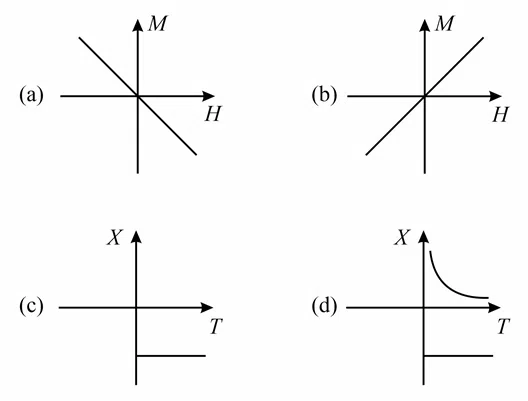
Which of the following combination will be represented by a diamagnetic material?
correct answer:- 4
Question 23
The magnetic potential due to a magnetic dipole at a point on its axis situated at a distance of $$20$$ cm from its center is $$1.5 \times 10^{-5}$$ T m. The magnetic moment of the dipole is _______ A m$$^2$$. (Given: $$\frac{\mu_0}{4\pi} = 10^{-7}$$ T m A$$^{-1}$$)
correct answer:- 6
Question 24
A bar magnet is demagnetized by inserting it inside a solenoid of length 0.2 m, 100 turns, and carrying a current of 5.2 A. The coercivity of the bar magnet is:
correct answer:- 2
Question 25
Two short bar magnets of length 1 cm each have magnetic moments 1.20 A m$$^2$$ and 1.00 A m$$^2$$ respectively. They are placed on a horizontal table parallel to each other with their N poles pointing towards the south. They have a common magnetic equator and are separated by a distance of 20.0 cm. The value of the resultant horizontal magnetic induction at the mid-point O of the line joining their centres is close to
(Horizontal component of earth's magnetic induction is $$3.6 \times 10^{-5}$$ Wb m$$^{-2}$$)
correct answer:- 4

Question 26
The magnetic susceptibility of a material of a rod is 499. Permeability in vacuum is $$4\pi \times 10^{-7}$$ Hm$$^{-1}$$. Absolute permeability of the material of the rod is:
correct answer:- 2
Question 27
The magnetic moment of a bar magnet is $$0.5$$ Am$$^2$$. It is suspended in a uniform magnetic field of $$8 \times 10^{-2}$$ T. The work done in rotating it from its most stable to most unstable position is:
correct answer:- 1
Question 28
A conductor of length $$l$$ is placed perpendicular to a horizontal uniform magnetic field $$B$$. Suddenly, a certain amount of charge is passed through it, when it is found to jump to a height $$h$$. The amount of charge that passes through the conductor is
correct answer:- 3
Question 29
A magnet hung at $$45°$$ with magnetic meridian makes an angle of $$60°$$ with the horizontal. The actual value of the angle of dip is
correct answer:- 1
Question 30
The hysteresis loop for a soft iron core is narrower than that of a carbon steel core. Which of the following properties is correct for soft iron over carbon steel based on this fact?
correct answer:- 3