JEE WhatsApp Group




JEE Waves PYQs
JEE Waves PYQs are a useful part of your Physics preparation because they help you understand how wave motion actually works in different situations. This chapter covers topics such as wavelength, frequency, wave speed, superposition, standing waves, beats, sound waves, organ pipes, stretched strings, and the Doppler effect.
At first, Waves may seem like a formula-heavy chapter, but most questions become manageable once the basic ideas are clear. You need to understand how particles in a medium move, how energy travels through a wave, and how different quantities such as frequency, wavelength, and speed are connected. A clear picture of the wave often makes the calculation much simpler.
While preparing, avoid learning formulas in isolation. Try to connect each equation with the physical situation in which it is used. Regular practice with JEE Waves Questions can help you recognise familiar patterns and improve your confidence. Solving chapter-wise JEE Questions is also useful because it shows you how the same concept can be asked in different ways.
This page includes important previous-year questions, a formula section, common mistakes, and a short preparation strategy. You can use it for quick revision before tests or alongside your regular study plan.
JEE Waves Important PYQs PDF
The PYQ PDF can include questions from the most frequently tested parts of the chapter. These may cover travelling waves, wave equations, speed of waves on a string, standing waves, beats, Doppler effect, open and closed organ pipes, and different modes of vibration.
Working through these questions helps you understand which concepts appear often and how they are usually framed in the exam. Some problems are mostly numerical, while others test whether you can read a graph, identify a harmonic, or understand the direction of wave motion. Solving questions from JEE Mains Previous Papers can give you a better idea of the actual level and style of the examination.
Important Waves Formula Sheet for JEE
Most questions from this chapter can be solved using a small group of important formulas. The real challenge is not remembering them, but knowing which one fits the situation.
You can download the complete Waves Formula Sheet from the link above. It can also be added to your JEE Mains Formula Sheet for quick revision before practice sessions and tests.
| Concept | Formula |
|---|---|
| Wave Speed | v = fλ |
| Angular Frequency | ω = 2πf |
| Wave Number | k = 2π/λ |
| Progressive Wave Equation | y = A sin(kx − ωt) |
| Time Period | T = 1/f |
| Speed of Wave on a String | v = √(T/μ) |
| Beat Frequency | fᵦ = |f₁ − f₂| |
| Fundamental Frequency of a String | f = v/2L |
| Fundamental Frequency of an Open Pipe | f = v/2L |
| Fundamental Frequency of a Closed Pipe | f = v/4L |
These formulas are commonly used in questions based on travelling waves, standing waves, strings, organ pipes, beats, and sound. Revising them with reliable JEE Study Material can make formula selection easier and reduce small calculation mistakes.
Common Mistakes to Avoid in JEE Waves PYQs
Most mistakes in this chapter happen because students rush through the question and miss an important detail.
Confusing amplitude and wavelength
Amplitude tells you the maximum displacement of a particle, while wavelength is the distance between two points in the same phase. They describe completely different properties of a wave.
Using the wrong expression for wave speed
Wave speed depends on the medium and the type of wave. For example, the speed of a wave on a stretched string depends on tension and linear mass density.
Missing the correct harmonic
Questions on strings and organ pipes often ask about a specific harmonic or overtone. Make sure you identify whether the pipe is open or closed before using a formula.
Applying the Doppler effect without checking motion
First decide whether the source, observer, or both are moving. The direction of motion matters, so it is better to understand the situation before substituting values.
Avoiding diagrams
A quick sketch can make standing-wave questions much easier. It helps you identify nodes, antinodes, wavelength, and the mode of vibration.
Attempting a JEE Mains Mock Test after revising the chapter can help you notice these mistakes and improve your speed under exam conditions.
How to Prepare Waves for JEE
Start with the basic relation between speed, frequency, and wavelength. Once that is clear, move on to progressive waves, superposition, standing waves, strings, and organ pipes. Keep beats and Doppler effect for the end, as they become easier when the earlier concepts are strong.
While solving a numerical, take a few seconds to identify the type of wave and the information given. Do not jump straight to a formula. This small habit can help you avoid many unnecessary errors and make unfamiliar questions easier to handle.
List of JEE Waves PYQs
Below is a test-style set of questions based on wave motion, standing waves, strings, organ pipes, beats, and the Doppler effect. Try to solve each question on your own before checking the answer.
Question 1
A string 2.0 m long and fixed at its ends is driven by a 240 Hz vibrator. The string vibrates in its third harmonic mode. The speed of the wave and its fundamental frequency is:
correct answer:- 2
Question 2
A wire of length $$L$$ and mass per unit length $$6.0 \times 10^{-3}$$ kg m$$^{-1}$$ is put under tension of 540 N. Two consecutive frequencies that it resonates at are: 420 Hz and 490 Hz. Then $$L$$ in meters is:
correct answer:- 1
Question 3
A stationary source emits sound waves of frequency 500 Hz. Two observers moving along a line passing through the source detect sound to be of frequencies 480 Hz and 530 Hz. Their respective speeds are, in m s$$^{-1}$$,
(Given speed of sound = 300 m/s)
correct answer:- 3
Question 4
A string of length 1 m and mass 5 g is fixed at both ends. The tension in the string is 8.0 N. The string is set into vibration using an external vibrator of frequency 100 Hz. The separation between successive nodes on the string is close to:
correct answer:- 1
Question 5
A travelling harmonic wave is represented by the equation $$y(x, t) = 10^{-3} \sin(50t + 2x)$$, where x and y are in meter and t is in seconds. Which of the following is a correct statement about the wave?
correct answer:- 3

Question 6
Displacement of a wave is expressed as $$x(t) = 5\cos\left(628t + \frac{\pi}{2}\right)$$ m. The wavelength of the wave when its velocity is 300 m/s is :
correct answer:- 2
Question 7
A uniform thin rope of length 12 m and mass 6 kg hangs vertically from a rigid support and a block of mass 2 kg is attached to its free end. A transverse short wave train of wavelength 6 cm is produced at the lower end of the rope. What is the wavelength of the wave train (in cm) when it reaches the top of the rope?
correct answer:- 3
Question 8
For a certain organ pipe, the first three resonance frequencies are in the ratio of $$1 : 3 : 5$$ respectively. If the frequency of fifth harmonic is $$405$$ Hz and the speed of sound in air is $$324$$ m s$$^{-1}$$, the length of the organ pipe is _____ m.
correct answer:- 1
Question 9
In a Young's double-slit experiment, the slits are separated by a distance of $$0.2\text{ mm}$$ and the screen is placed $$1.2\text{ m}$$ away from the slits. The whole apparatus is immersed in water of refractive index $$4/3$$. If the wavelength of light used in air is $$6000\text{ \AA}$$, the fringe width observed on the screen inside water is:
correct answer:- 1
Question 10
A uniform rope of mass $$m$$ and length $$L$$ hangs vertically from a rigid support. A transverse wave pulse is produced at the lower free end of the rope. The time taken ($$t$$) by this wave pulse to travel from the bottom to the top support of the rope is given by the expression:
correct answer:- 3

Question 11
Three harmonic waves having equal frequency $$\nu$$ and same intensity $$I_0$$, have phase angles $$0$$, $$\frac{\pi}{4}$$ and $$-\frac{\pi}{4}$$ respectively. When they are superimposed the intensity of the resultant wave is close to:
correct answer:- 1
Question 12
Speed of a transverse wave on a straight wire (mass 6.0 g, length 60 cm and area of cross-section 1.0 mm$$^2$$) is 90 m s$$^{-1}$$. If the Young's modulus of wire is $$16 \times 10^{11}$$ N m$$^{-2}$$, the extension of wire over its natural length is:
correct answer:- 1
Question 13
A localized wave pulse on a long, taut string with linear mass density $$\lambda$$ is described at any position $$x$$ and time $$t$$ by the wave function:
$$y(x,t) = \frac{b^3}{b^2 + (x - vt)^2}$$
where $$b$$ is a positive constant and $$v$$ represents the propagation velocity of the wave pulse along the string. Determine the total mechanical energy carried by this entire wave pulse.
correct answer:- 1
Question 14
Two travelling waves of equal amplitudes and equal frequencies move in opposite directions along a string. They interfere to produce a stationary wave whose equation is given by $$y = \left(10 \cos \pi x \sin \frac{2\pi t}{T}\right)$$ cm. The amplitude of the particle at $$x = \frac{4}{3}$$ cm will be ______ cm.
correct answer:- 5
Question 15
Two wires $$W_1$$ and $$W_2$$ have the same radius $$r$$ and respective densities $$\rho_1$$ and $$\rho_2$$, such that $$\rho_2 = 4\rho_1$$. They are joined together at the point $$O$$, as shown in the figure. The combination is used as a sonometer wire and kept under tension $$T$$. The point $$O$$ is midway between the two bridges. When a stationary wave is set up in the composite wire, the joint is found to be a node. The ratio of the number of antinodes formed in $$W_1$$ to $$W_2$$ is:
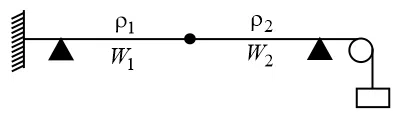
correct answer:- 2

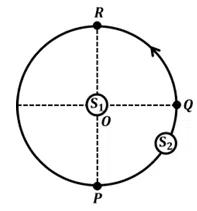
$$S_1$$ and $$S_2$$ are two identical sound sources of frequency 656 Hz. The source $$S_1$$ is located at O and $$S_2$$ moves anti-clockwise with a uniform speed $$4\sqrt{2}$$ ms$$^{-1}$$ on a circular path around O, as shown in the figure. There are three points P, Q and R on this path such that P and R are diametrically opposite while Q is equidistant from them. A sound detector is placed at point P. The source $$S_1$$ can move along direction OP.
[Given: The speed of sound in air is 324 ms$$^{-1}$$]
Question 16
Consider both sources emitting sound. When $$S_2$$ is at R and $$S_1$$ approaches the detector with a speed 4 ms$$^{-1}$$, the beat frequency measured by the detector is ____ Hz.
correct answer:- 8.2
Question 17
Two strings (A, B) having linear densities $$\mu_{A}=2\times10^{-4}kg/m\text{ and },\mu_{B}=4\times10^{-4}kg/m$$ and lengths $$L_{A}=2.5m$$ and $$L_{B}=1.5m$$ respectively are joined. Free ends of A and B are tied to two rigid supports C and D, respectively creating a tension of 500 N in the wire. Two identical pulses, sent from C and D ends, take time $$t_{1}\text{ and } t_{2}$$, respectively, to reach the joint. The ratio $$t_{1}/ t_{2}$$ is :
correct answer:- 4
Question 18
The percentage increase in the speed of transverse waves produced in a stretched string if the tension is increased by 4%, will be ______ %.
correct answer:- 2
Question 19
The velocity of sound in a gas, in which two wavelengths $$4.08$$ m and $$4.16$$ m produce $$40$$ beats in $$12$$ s, will be
correct answer:- 4
Question 20
If a wave gets refracted into a denser medium, then which of the following is true?
correct answer:- 3

Question 21
The first overtone frequency of an open organ pipe is equal to the fundamental frequency of a closed organ pipe. If the length of the closed organ pipe is $$20$$ cm. The length of the open organ pipe is ______ cm
correct answer:- 80
Question 22
Two cars are approaching each other at an equal speed of 7.2 km hr$$^{-1}$$. When they see each other, both blow horns having a frequency of 676 Hz. The beat frequency heard by each driver will be ______ Hz. [Velocity of sound in air is 340 m s$$^{-1}$$.]
correct answer:- 8
Question 23
The mass per unit length of a uniform wire is 0.135 g cm$$^{-1}$$. A transverse wave of the form $$y = -0.21\sin(x + 30t)$$ is produced in it, where $$x$$ is in meter and $$t$$ is in second. Then, the expected value of tension in the wire is $$x \times 10^{-2}$$ N. Value of $$x$$ is ______ (Round-off to the nearest integer)
correct answer:- 1215
Question 24
A particle executing simple harmonic motion (SHM) has a maximum velocity $$v_{\text{max}}$$ and a maximum acceleration $$a_{\text{max}}$$. The amplitude ($$A$$) of the motion is given by the expression:
correct answer:- 1
Question 25
A travelling wave is described by the equation $$y(x, t) = 0.05\sin(8x - 4t)$$ m. The velocity of the wave is: [All the quantities are in SI unit]
correct answer:- 3

Question 26
In a resonance tube experiment when the tube is filled with water up to a height of $$17.0\,\text{cm}$$, from bottom, it resonates with a given tuning fork. When the water level is raised the next resonance with the same tuning fork occurs at a height of $$24.5\,\text{cm}$$. If the velocity of sound in air is $$330\,\text{m s}^{-1}$$, the tuning fork frequency is:
correct answer:- 1
Question 27
A person observes two moving trains, $$A$$ reaching the station and $$B$$ leaving the station with equal speed of $$30$$ m s$$^{-1}$$. If both trains emit sounds with frequency $$300$$ Hz, (Speed of sound: $$330$$ m s$$^{-1}$$) approximate difference of frequencies heard by the person will be:
correct answer:- 2
Question 28
A student is performing the experiment of the resonance column. The diameter of the column tube is 6 cm. The frequency of the tuning fork is 504 Hz. Speed of the sound at the given temperature is 336 m s$$^{-1}$$. The zero of the meter scale coincides with the top end of the resonance column tube. The reading of the water level in the column when the first resonance occurs is:
correct answer:- 1
Question 29
A tuning fork is vibrating at 250 Hz. The length of the shortest closed organ pipe that will resonate with the tuning fork will be _________ cm. (Take speed of sound in air as 340 m s$$^{-1}$$)
correct answer:- 34
Question 30
A set of $$20$$ tuning forks is arranged in a series of increasing frequencies. If each fork gives $$4$$ beats with respect to the preceding fork and the frequency of the last fork is twice the frequency of the first, then the frequency of last fork is ______ Hz.
correct answer:- 152