
Join Our JEE Preparation Group
Prep with like-minded aspirants; Get access to free daily tests and study material.
Sign in
Please select an account to continue using cracku.in
↓ →
Join Our JEE Preparation Group
Prep with like-minded aspirants; Get access to free daily tests and study material.
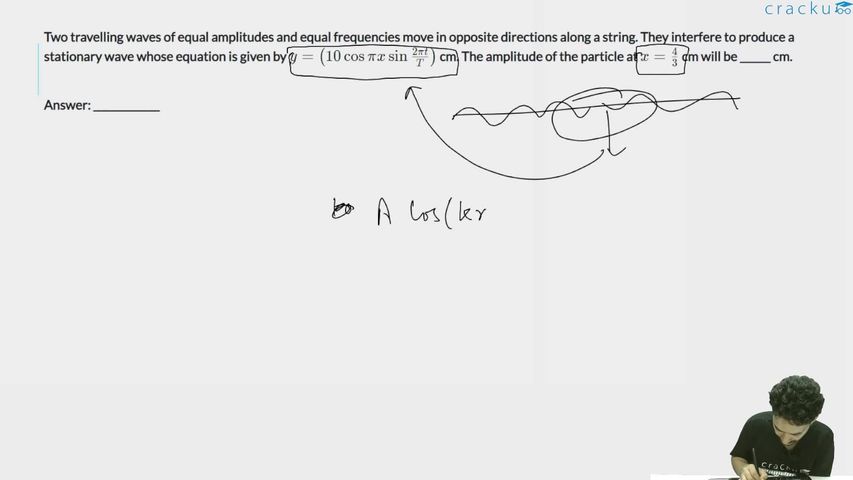
Two travelling waves of equal amplitudes and equal frequencies move in opposite directions along a string. They interfere to produce a stationary wave whose equation is given by $$y = \left(10 \cos \pi x \sin \frac{2\pi t}{T}\right)$$ cm. The amplitude of the particle at $$x = \frac{4}{3}$$ cm will be ______ cm.
Correct Answer: 5
The stationary wave equation is given as $$y = 10\cos(\pi x)\sin\left(\frac{2\pi t}{T}\right)$$ cm, and we seek the amplitude at $$x = \frac{4}{3}$$ cm. Since a stationary wave of the form $$y = A\cos(kx)\sin(\omega t)$$ has an amplitude at position $$x$$ equal to $$\text{Amplitude at } x = |A\cos(kx)|$$, we identify the parameters from the given equation as $$A = 10$$ cm and $$k = \pi$$ rad/cm.
Substituting $$x = \frac{4}{3}$$ cm into the amplitude expression yields: $$\text{Amplitude} = \left|10\cos\left(\pi \times \frac{4}{3}\right)\right| = \left|10\cos\left(\frac{4\pi}{3}\right)\right|$$. Now, since the angle $$\frac{4\pi}{3}$$ lies in the third quadrant ($$\pi + \frac{\pi}{3}$$), we have $$\cos\left(\frac{4\pi}{3}\right) = \cos\left(\pi + \frac{\pi}{3}\right) = -\cos\left(\frac{\pi}{3}\right) = -\frac{1}{2}$$.
This gives the amplitude as $$\text{Amplitude} = \left|10 \times \left(-\frac{1}{2}\right)\right| = |-5| = 5 \text{ cm}$$.
The answer is $$5$$ cm.
Was this solution helpful?
Click on the Email ☝️ to Watch the Video Solution
Create a FREE account and get:
_1.webp)

Educational materials for JEE preparation

Ask our AI anything

AI can make mistakes. Please verify important information.
AI can make mistakes. Please verify important information.
