
Join Our JEE Preparation Group
Prep with like-minded aspirants; Get access to free daily tests and study material.
Sign in
Please select an account to continue using cracku.in
↓ →
Join Our JEE Preparation Group
Prep with like-minded aspirants; Get access to free daily tests and study material.
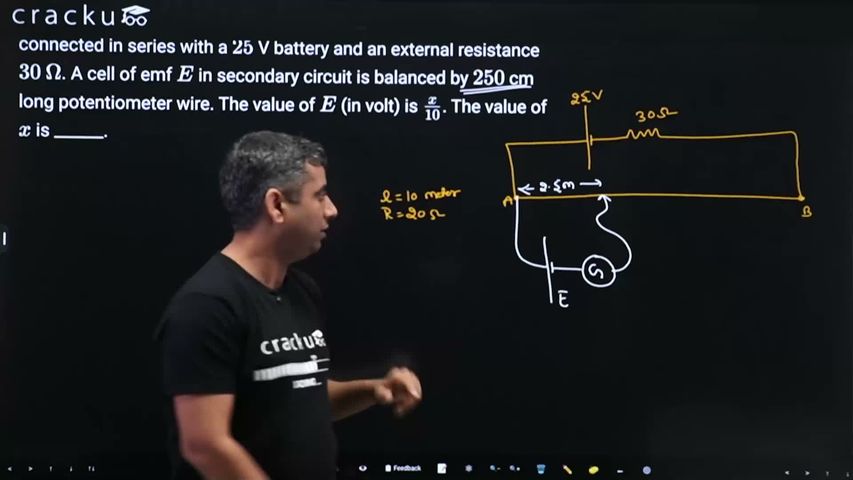
A potentiometer wire of length $$10$$ m and resistance $$20$$ $$\Omega$$ is connected in series with a $$25$$ V battery and an external resistance $$30$$ $$\Omega$$. A cell of emf $$E$$ in secondary circuit is balanced by $$250$$ cm long potentiometer wire. The value of $$E$$ (in volt) is $$\frac{x}{10}$$. The value of $$x$$ is ______.
Correct Answer: 25
A potentiometer wire of length $$10$$ m and resistance $$20$$ $$\Omega$$ is connected in series with a $$25$$ V battery and an external resistance of $$30$$ $$\Omega$$. A cell of emf $$E$$ is balanced at $$250$$ cm. We need to find $$x$$ where $$E = \frac{x}{10}$$.
Since the potentiometer wire and the external resistance are in series, the total resistance in the primary circuit is $$R_{total} = R_{wire} + R_{ext} = 20 + 30 = 50 \text{ }\Omega$$ and the current through the circuit is $$I = \frac{V}{R_{total}} = \frac{25}{50} = 0.5 \text{ A}$$.
Substituting this current into the expression for the potential drop across the wire gives $$V_{wire} = I \times R_{wire} = 0.5 \times 20 = 10 \text{ V}$$.
This voltage drop along the wire corresponds to a potential gradient of $$k = \frac{V_{wire}}{L} = \frac{10}{10} = 1 \text{ V/m}$$.
When the balancing length is $$l = 250$$ cm $$= 2.5$$ m, the emf of the cell is $$E = k \times l = 1 \times 2.5 = 2.5 \text{ V}$$. Since $$E = \frac{x}{10}$$, substituting gives $$2.5 = \frac{x}{10}$$ and hence $$x = 25$$.
The answer is $$25$$.
Was this solution helpful?
Click on the Email ☝️ to Watch the Video Solution
Create a FREE account and get:
_1.webp)

Educational materials for JEE preparation

Ask our AI anything

AI can make mistakes. Please verify important information.
AI can make mistakes. Please verify important information.
