
Join Our JEE Preparation Group
Prep with like-minded aspirants; Get access to free daily tests and study material.
Sign in
Please select an account to continue using cracku.in
↓ →
Join Our JEE Preparation Group
Prep with like-minded aspirants; Get access to free daily tests and study material.
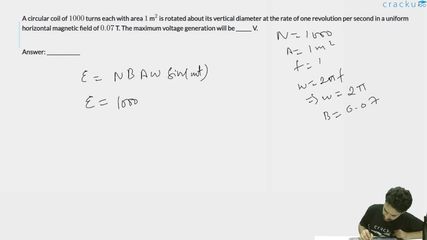
A circular coil of $$1000$$ turns each with area $$1$$ m$$^2$$ is rotated about its vertical diameter at the rate of one revolution per second in a uniform horizontal magnetic field of $$0.07$$ T. The maximum voltage generation will be ______ V.
Correct Answer: 440
A circular coil of $$1000$$ turns, each with area $$1$$ m$$^2$$, is rotated about its vertical diameter at the rate of one revolution per second in a uniform horizontal magnetic field of $$0.07$$ T. We need to find the maximum voltage generated.
Recall that the instantaneous EMF induced in a rotating coil is given by
$$\varepsilon = NBA\omega \sin(\omega t)$$
Since the maximum value occurs when $$\sin(\omega t) = 1$$, this leads to
$$\varepsilon_{max} = NBA\omega$$
As the coil completes one revolution per second, its angular frequency is
$$\omega = 2\pi f = 2\pi \times 1 = 2\pi \text{ rad/s}$$
Substituting $$N = 1000$$, $$B = 0.07$$ T, $$A = 1$$ m$$^2$$ and $$\omega = 2\pi$$ rad/s into the expression for $$\varepsilon_{max}$$ gives
$$\varepsilon_{max} = 1000 \times 0.07 \times 1 \times 2\pi$$
$$\varepsilon_{max} = 70 \times 2\pi = 140\pi$$
Evaluating this numerically yields
$$\varepsilon_{max} = 140 \times \frac{22}{7} = 140 \times 3.1429 = 440 \text{ V}$$
Therefore, the maximum voltage generated is 440 V.
Was this solution helpful?
Click on the Email ☝️ to Watch the Video Solution
Create a FREE account and get:
_1.webp)

Educational materials for JEE preparation

Ask our AI anything

AI can make mistakes. Please verify important information.
AI can make mistakes. Please verify important information.
