
Join Our JEE Preparation Group
Prep with like-minded aspirants; Get access to free daily tests and study material.
Sign in
Please select an account to continue using cracku.in
↓ →
Join Our JEE Preparation Group
Prep with like-minded aspirants; Get access to free daily tests and study material.
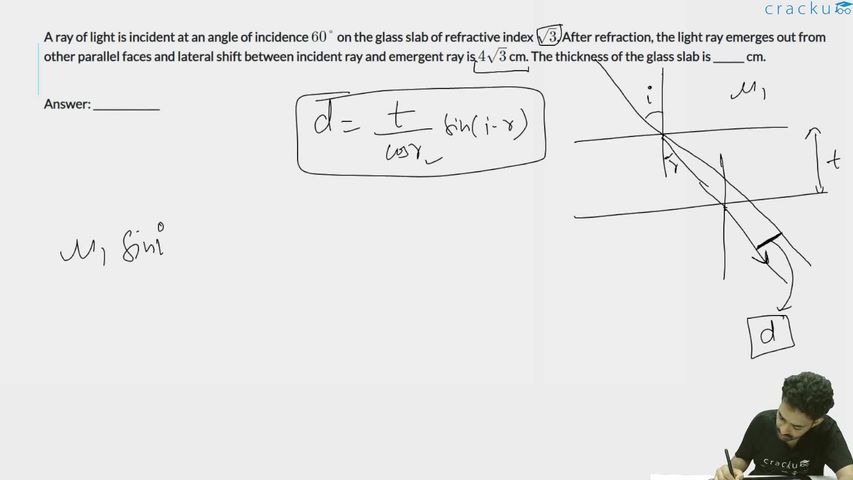
A ray of light is incident at an angle of incidence $$60°$$ on the glass slab of refractive index $$\sqrt{3}$$. After refraction, the light ray emerges out from other parallel faces and lateral shift between incident ray and emergent ray is $$4\sqrt{3}$$ cm. The thickness of the glass slab is ______ cm.
Correct Answer: 12
A ray of light is incident at $$60°$$ on a glass slab of refractive index $$\sqrt{3}$$. The lateral shift is $$4\sqrt{3}$$ cm. We need to find the thickness of the glass slab.
Using Snell’s law, we have:
$$n_1 \sin i = n_2 \sin r$$
Substituting the given values yields:
$$1 \times \sin 60° = \sqrt{3} \times \sin r$$
which simplifies to:
$$\frac{\sqrt{3}}{2} = \sqrt{3} \sin r$$
and hence:
$$\sin r = \frac{1}{2}$$
giving:
$$r = 30°$$
The lateral shift $$d$$ for a parallel glass slab is given by:
$$d = \frac{t}{\cos r} \sin(i - r)$$
Substituting $$i = 60°$$, $$r = 30°$$, and $$d = 4\sqrt{3}$$ cm, we get:
$$4\sqrt{3} = \frac{t}{\cos 30°} \sin(60° - 30°)$$
Since $$\cos 30° = \frac{\sqrt{3}}{2}$$ and $$\sin 30° = \frac{1}{2}$$, this becomes:
$$4\sqrt{3} = \frac{t}{\frac{\sqrt{3}}{2}} \times \frac{1}{2}$$
or equivalently:
$$4\sqrt{3} = \frac{t}{\sqrt{3}}$$
Multiplying both sides by $$\sqrt{3}$$ gives:
$$t = 4\sqrt{3} \times \sqrt{3} = 4 \times 3 = 12 \text{ cm}$$
Therefore, the answer is $$12$$ cm.
Was this solution helpful?
Click on the Email ☝️ to Watch the Video Solution
Create a FREE account and get:
_1.webp)

Educational materials for JEE preparation

Ask our AI anything

AI can make mistakes. Please verify important information.
AI can make mistakes. Please verify important information.
