
Join Our JEE Preparation Group
Prep with like-minded aspirants; Get access to free daily tests and study material.
Sign in
Please select an account to continue using cracku.in
↓ →
Join Our JEE Preparation Group
Prep with like-minded aspirants; Get access to free daily tests and study material.
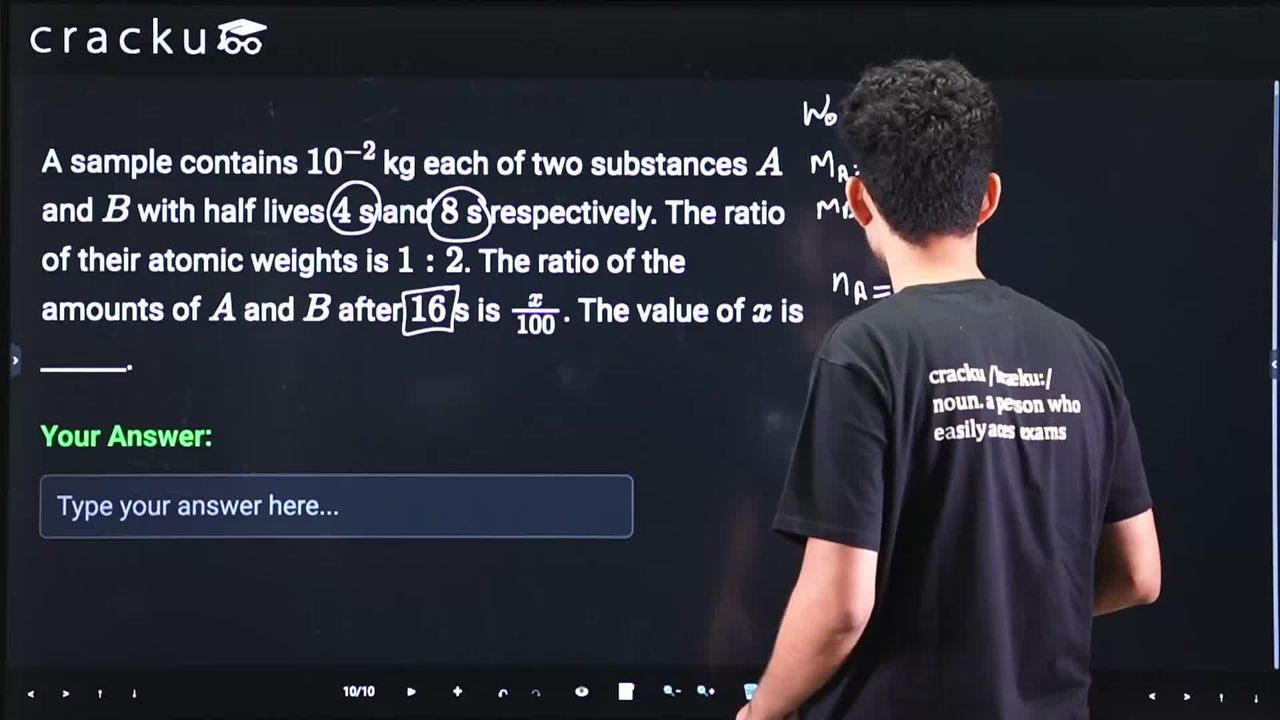
A sample contains $$10^{-2}$$ kg each of two substances $$A$$ and $$B$$ with half lives $$4$$ s and $$8$$ s respectively. The ratio of their atomic weights is $$1 : 2$$. The ratio of the amounts of $$A$$ and $$B$$ after $$16$$ s is $$\frac{x}{100}$$. The value of $$x$$ is ______.
Correct Answer: 25
A sample contains $$10^{-2}$$ kg each of substances $$A$$ and $$B$$ with half-lives $$4$$ s and $$8$$ s respectively, and the ratio of their atomic weights is $$1:2$$. We need to find the ratio of the remaining amounts of $$A$$ and $$B$$ after $$16$$ s.
Let the atomic weight of $$A$$ be $$M$$ and that of $$B$$ be $$2M$$. Since the initial mass of each substance is $$10^{-2}$$ kg, or $$10$$ g, the initial number of moles is:
$$n_A^0 = \frac{10}{M}, \quad n_B^0 = \frac{10}{2M} = \frac{5}{M}$$
The radioactive decay law states:
$$N = N_0 \left(\frac{1}{2}\right)^{t/T_{1/2}}$$
Substituting $$t = 16$$ s shows that $$A$$ undergoes $$\tfrac{16}{4} = 4$$ half-lives, while $$B$$ undergoes $$\tfrac{16}{8} = 2$$ half-lives. This gives the remaining number of moles as:
$$n_A = n_A^0 \times \left(\frac{1}{2}\right)^4 = \frac{10}{M} \times \frac{1}{16} = \frac{10}{16M}$$
$$n_B = n_B^0 \times \left(\frac{1}{2}\right)^2 = \frac{5}{M} \times \frac{1}{4} = \frac{5}{4M}$$
Converting these amounts back to mass yields:
$$m_A = n_A \times M = \frac{10}{16M} \times M = \frac{10}{16} = \frac{5}{8}$$
$$m_B = n_B \times 2M = \frac{5}{4M} \times 2M = \frac{10}{4} = \frac{5}{2}$$
From the above, the ratio of the remaining masses is
$$\frac{m_A}{m_B} = \frac{5/8}{5/2} = \frac{5}{8} \times \frac{2}{5} = \frac{1}{4} = \frac{25}{100}$$
Since this ratio is expressed as $$\frac{x}{100}$$, we have
$$\frac{x}{100} = \frac{25}{100}$$
$$x = 25$$
The answer is $$25$$.
Was this solution helpful?
Click on the Email ☝️ to Watch the Video Solution
Create a FREE account and get:
_1.webp)

Educational materials for JEE preparation

Ask our AI anything

AI can make mistakes. Please verify important information.
AI can make mistakes. Please verify important information.
