
Join Our JEE Preparation Group
Prep with like-minded aspirants; Get access to free daily tests and study material.
Sign in
Please select an account to continue using cracku.in
↓ →
Join Our JEE Preparation Group
Prep with like-minded aspirants; Get access to free daily tests and study material.
A wire of length $$L$$ and mass per unit length $$6.0 \times 10^{-3}$$ kg m$$^{-1}$$ is put under tension of 540 N. Two consecutive frequencies that it resonates at are: 420 Hz and 490 Hz. Then $$L$$ in meters is:
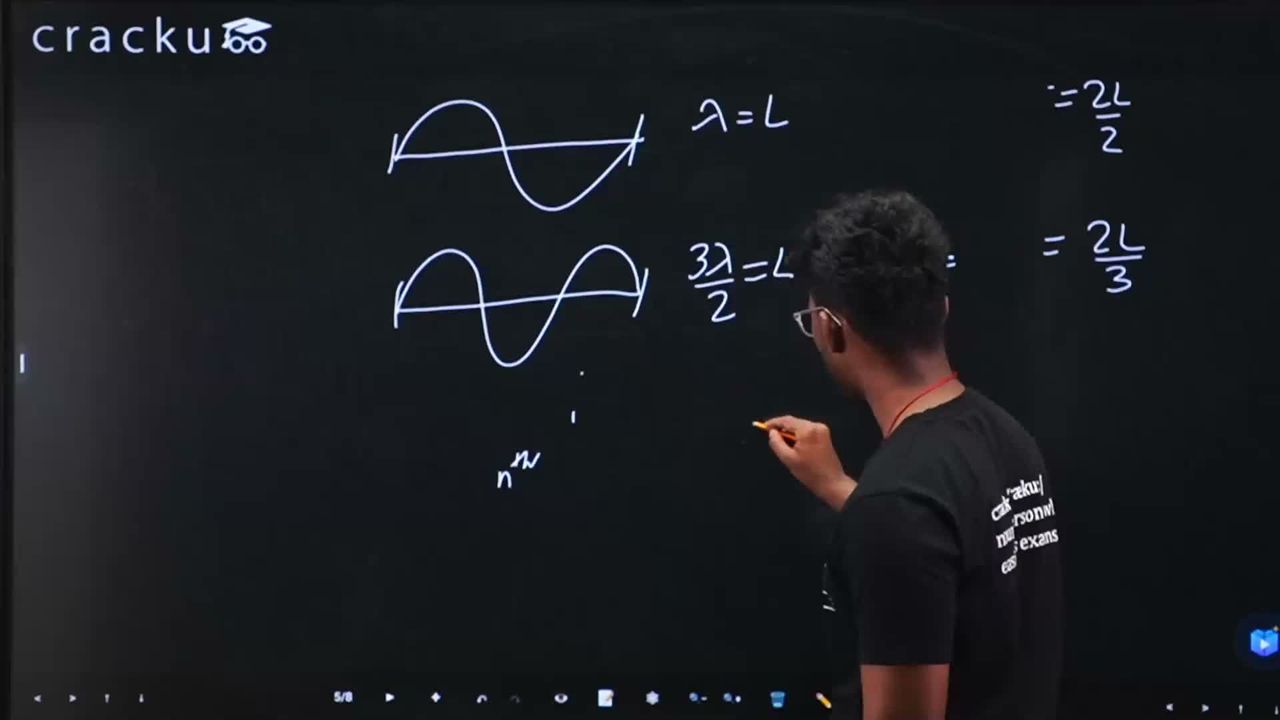
We begin by noting that a stretched string fixed at both ends can vibrate in normal modes whose frequencies are given by the well-known formula
$$f_n=\dfrac{n v}{2L},$$
where $$f_n$$ is the frequency of the $$n^{\text{th}}$$ harmonic, $$v$$ is the speed of transverse waves on the string, and $$L$$ is the length of the string.
Before using the formula, we must first find the wave speed $$v$$ on the string. The speed of a wave on a stretched string is determined by the tension $$T$$ and the mass per unit length $$\mu$$ through the relation
$$v=\sqrt{\dfrac{T}{\mu}}.$$
We are given
$$T=540\ \text{N}, \qquad \mu = 6.0\times10^{-3}\ \text{kg m}^{-1}.$$
Substituting these values, we have
$$v=\sqrt{\dfrac{540}{6.0\times10^{-3}}}.$$
Inside the square root, the denominator is converted to a simpler decimal:
$$6.0\times10^{-3}=0.006.$$
So,
$$v=\sqrt{\dfrac{540}{0.006}}.$$
Carrying out the division first,
$$\dfrac{540}{0.006}=90\,000.$$
Taking the square root gives
$$v=\sqrt{90\,000}=300\ \text{m s}^{-1}.$$
Now, we are told that two consecutive resonant frequencies are $$420\ \text{Hz}$$ and $$490\ \text{Hz}$$. Let the lower of these, $$420\ \text{Hz}$$, correspond to harmonic number $$n$$. Then the higher one, $$490\ \text{Hz}$$, must correspond to harmonic number $$n+1$$. Using the formula for successive harmonics, we may write
$$f_{n+1}-f_n=\dfrac{v}{2L}.$$
The left-hand side is simply the numerical difference of the two given frequencies:
$$f_{n+1}-f_n = 490-420 = 70\ \text{Hz}.$$
Therefore,
$$70 = \dfrac{v}{2L}.$$
We have already found $$v=300\ \text{m s}^{-1}$$, so we substitute this value:
$$70 = \dfrac{300}{2L}.$$
Simplify the fraction in the numerator first:
$$\dfrac{300}{2L} = \dfrac{150}{L}.$$
Hence the equation becomes
$$70 = \dfrac{150}{L}.$$
To isolate $$L$$, we cross-multiply:
$$70L = 150.$$
Now, solve for $$L$$ by dividing both sides by 70:
$$L = \dfrac{150}{70}.$$
Reduce the fraction by dividing numerator and denominator by 10:
$$L = \dfrac{15}{7}\ \text{m}.$$
Carrying out the division for a decimal value,
$$L \approx 2.142857\ \text{m}.$$
Among the given choices, the closest value is 2.1 m, which corresponds to Option A.
Hence, the correct answer is Option A.
Was this solution helpful?
Click on the Email ☝️ to Watch the Video Solution
Create a FREE account and get:
_1.webp)

Educational materials for JEE preparation

Ask our AI anything

AI can make mistakes. Please verify important information.
AI can make mistakes. Please verify important information.
