
Join Our JEE Preparation Group
Prep with like-minded aspirants; Get access to free daily tests and study material.
Sign in
Please select an account to continue using cracku.in
↓ →
Join Our JEE Preparation Group
Prep with like-minded aspirants; Get access to free daily tests and study material.
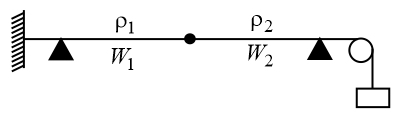
Two wires $$W_1$$ and $$W_2$$ have the same radius $$r$$ and respective densities $$\rho_1$$ and $$\rho_2$$, such that $$\rho_2 = 4\rho_1$$. They are joined together at the point $$O$$, as shown in the figure. The combination is used as a sonometer wire and kept under tension $$T$$. The point $$O$$ is midway between the two bridges. When a stationary wave is set up in the composite wire, the joint is found to be a node. The ratio of the number of antinodes formed in $$W_1$$ to $$W_2$$ is:
Wave speed in a stretched string:
$$v=\sqrt{\frac{T}{\mu\ }}$$
Since radius is same, linear mass density:
$$\mu\ ∝\ ρ$$
Thus, $$\frac{v_1}{v_2}=\sqrt{\frac{\mu_2}{\mu_1\ }}=\sqrt{\frac{ρ_2}{ρ_1}}=\sqrt{4}=2$$
$$v_1=2\cdot v_2$$
Since the junction is a node, each segment behaves like an independent string fixed at both ends.
Number of antinodes:
$$n=\frac{2L}{λ}$$
Using $$v=fλ$$,
$$λ=\frac{v}{f}$$
$$n=\frac{2Lf}{v}$$
$$L_1=L_2\ \&\ f_1=f_2$$
Thus, the ratio of antinodes:
$$\frac{n_1}{n_2}=\frac{v_2}{v_1}=\frac{1}{2}$$
Was this solution helpful?
Create a FREE account and get:
_1.webp)

Educational materials for JEE preparation

Ask our AI anything

AI can make mistakes. Please verify important information.
AI can make mistakes. Please verify important information.


