
Join Our JEE Preparation Group
Prep with like-minded aspirants; Get access to free daily tests and study material.
Sign in
Please select an account to continue using cracku.in
↓ →
Join Our JEE Preparation Group
Prep with like-minded aspirants; Get access to free daily tests and study material.
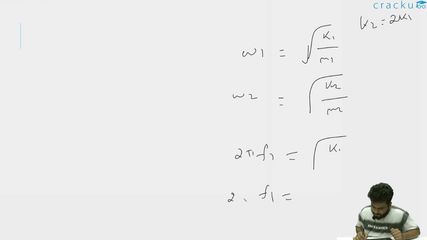
A 1 kg block attached to a spring vibrates with a frequency of 1 Hz on a frictionless horizontal table. Two springs identical to the original spring are attached in parallel to a 8 kg block placed on the same table. So, the frequency of vibration of the 8 kg block is:
For a mass-spring system executing simple harmonic motion on a frictionless horizontal surface, we first recall the standard relation between the frequency $$f$$, the spring constant $$k$$ and the mass $$m$$:
$$f \;=\; \frac{1}{2\pi}\,\sqrt{\frac{k}{m}}\,.$$
We are told that a block of mass $$m_1 = 1\ \text{kg}$$ attached to a single spring oscillates with frequency $$f_1 = 1\ \text{Hz}$$. Substituting these data in the above formula lets us determine the spring constant of the original spring.
$$f_1 \;=\; \frac{1}{2\pi}\,\sqrt{\frac{k}{m_1}} \;=\; \frac{1}{2\pi}\,\sqrt{\frac{k}{1}}\,.$$
Multiplying both sides by $$2\pi$$ and then squaring, we get
$$2\pi f_1 \;=\; \sqrt{k} \;\;\Longrightarrow\;\; k \;=\; (2\pi f_1)^2 \;=\; (2\pi \times 1)^2 \;=\; (2\pi)^2\,.$$
Now we consider the second arrangement. Two springs identical to the first one are connected in parallel and fastened to a block of mass $$m_2 = 8\ \text{kg}$$. For springs in parallel, the effective spring constant is the algebraic sum of the individual constants, so
$$k_{\text{eq}} \;=\; k + k \;=\; 2k\,.$$
The frequency of vibration of the 8 kg block will again be given by the same basic formula, but with $$k_{\text{eq}}$$ and $$m_2$$:
$$f_2 \;=\; \frac{1}{2\pi}\,\sqrt{\frac{k_{\text{eq}}}{m_2}} \;=\; \frac{1}{2\pi}\,\sqrt{\frac{2k}{8}}\,.$$
Simplifying the fraction inside the square root,
$$\frac{2k}{8} \;=\; \frac{k}{4}\,,$$
so
$$f_2 \;=\; \frac{1}{2\pi}\,\sqrt{\frac{k}{4}} \;=\; \frac{1}{2\pi}\,\cdot\frac{1}{2}\,\sqrt{k} \;=\; \frac{1}{2}\,\bigl(\frac{1}{2\pi}\sqrt{k}\bigr) \;=\; \frac{1}{2}\,f_1\,.$$
Because $$f_1 = 1\ \text{Hz}$$, we obtain
$$f_2 \;=\; \frac{1}{2}\times 1\ \text{Hz} \;=\; 0.5\ \text{Hz}\,.$$
Hence, the correct answer is Option D.
Was this solution helpful?
Click on the Email ☝️ to Watch the Video Solution
Create a FREE account and get:
_1.webp)

Educational materials for JEE preparation

Ask our AI anything

AI can make mistakes. Please verify important information.
AI can make mistakes. Please verify important information.


