
Join Our JEE Preparation Group
Prep with like-minded aspirants; Get access to free daily tests and study material.
Sign in
Please select an account to continue using cracku.in
↓ →
Join Our JEE Preparation Group
Prep with like-minded aspirants; Get access to free daily tests and study material.
Speed of a transverse wave on a straight wire (mass 6.0 g, length 60 cm and area of cross-section 1.0 mm$$^2$$) is 90 m s$$^{-1}$$. If the Young's modulus of wire is $$16 \times 10^{11}$$ N m$$^{-2}$$, the extension of wire over its natural length is:
First of all we note that the speed of a transverse wave on a stretched wire is governed by the well-known relation
$$v=\sqrt{\dfrac{T}{\mu}}$$
where $$v$$ is the speed of the wave, $$T$$ is the tension in the wire and $$\mu$$ is the mass per unit length.
We have the total mass of the wire $$m=6.0\ \text{g}=6.0\times10^{-3}\ \text{kg}$$ and its original length $$L=60\ \text{cm}=0.60\ \text{m}$$. Hence the mass per unit length is
$$\mu=\dfrac{m}{L}= \dfrac{6.0\times10^{-3}\ \text{kg}}{0.60\ \text{m}}=1.0\times10^{-2}\ \text{kg m}^{-1}.$$
The wave speed is given as $$v=90\ \text{m s}^{-1}$$. Substituting $$v$$ and $$\mu$$ in the formula and solving for the tension, we obtain
$$T=\mu v^{2}=\left(1.0\times10^{-2}\ \text{kg m}^{-1}\right)\left(90\ \text{m s}^{-1}\right)^{2}.$$
Calculating the square first, $$90^{2}=8100$$, and then multiplying,
$$T = 1.0\times10^{-2}\times 8100\ \text{N}=81\ \text{N}.$$
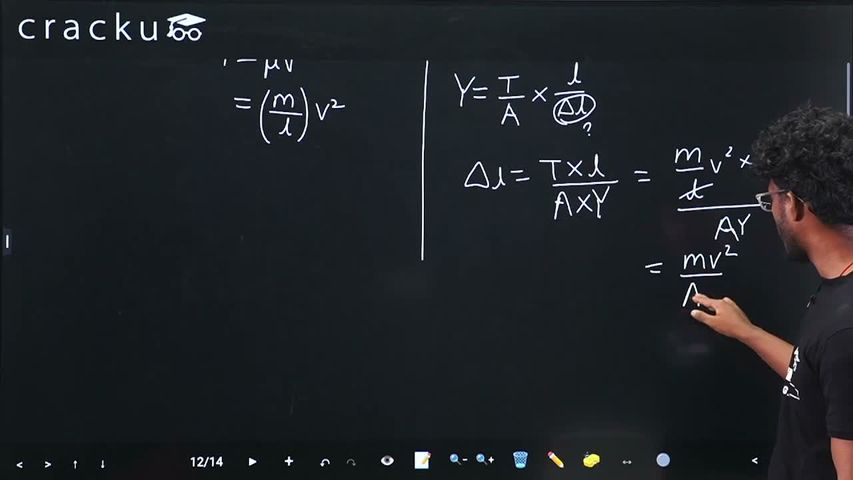
To find the extension produced by this tension we invoke Hooke’s law for a uniform wire. The longitudinal strain is related to stress and Young’s modulus by
$$\frac{\Delta L}{L} = \frac{\text{Stress}}{Y} = \frac{T/A}{Y},$$
where $$A$$ is the cross-sectional area and $$Y$$ is Young’s modulus. Rearranging, the extension $$\Delta L$$ becomes
$$\Delta L=\frac{T\,L}{A\,Y}.$$
The cross-sectional area is given as $$1.0\ \text{mm}^{2}$$. In SI units this is
$$A = 1.0\ \text{mm}^{2}=1.0\times10^{-6}\ \text{m}^{2}.$$
The Young’s modulus is supplied as $$Y = 16\times10^{11}\ \text{N m}^{-2}.$$
Substituting every quantity into the extension formula, we get
$$\Delta L = \frac{(81\ \text{N})\,(0.60\ \text{m})}{\left(1.0\times10^{-6}\ \text{m}^{2}\right)\,\left(16\times10^{11}\ \text{N m}^{-2}\right)}.$$
Multiplying the numerator,
$$T\,L = 81 \times 0.60 = 48.6\ \text{N m}.$$
Working out the denominator, notice that
$$A\,Y = \left(1.0\times10^{-6}\right)\left(16\times10^{11}\right)=16\times10^{5}=1.6\times10^{6}.$$
Thus,
$$\Delta L = \frac{48.6}{1.6\times10^{6}}\ \text{m}.$$
Carrying out the division,
$$\Delta L = 3.0375\times10^{-5}\ \text{m}.$$
To express this result in millimetres we recall that $$1\ \text{mm}=10^{-3}\ \text{m}$$, so
$$\Delta L = \dfrac{3.0375\times10^{-5}\ \text{m}}{10^{-3}\ \text{m/mm}}=3.0375\times10^{-2}\ \text{mm}\approx 0.03\ \text{mm}.$$
Hence, the correct answer is Option A.
Was this solution helpful?
Click on the Email ☝️ to Watch the Video Solution
Create a FREE account and get:
_1.webp)

Educational materials for JEE preparation

Ask our AI anything

AI can make mistakes. Please verify important information.
AI can make mistakes. Please verify important information.


