
Join Our JEE Preparation Group
Prep with like-minded aspirants; Get access to free daily tests and study material.
Sign in
Please select an account to continue using cracku.in
↓ →
Join Our JEE Preparation Group
Prep with like-minded aspirants; Get access to free daily tests and study material.
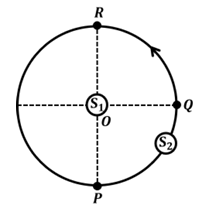
$$S_1$$ and $$S_2$$ are two identical sound sources of frequency 656 Hz. The source $$S_1$$ is located at O and $$S_2$$ moves anti-clockwise with a uniform speed $$4\sqrt{2}$$ ms$$^{-1}$$ on a circular path around O, as shown in the figure. There are three points P, Q and R on this path such that P and R are diametrically opposite while Q is equidistant from them. A sound detector is placed at point P. The source $$S_1$$ can move along direction OP.
[Given: The speed of sound in air is 324 ms$$^{-1}$$]
Consider both sources emitting sound. When $$S_2$$ is at R and $$S_1$$ approaches the detector with a speed 4 ms$$^{-1}$$, the beat frequency measured by the detector is ____ Hz.
Correct Answer: 8.2
For a beat to be heard, the detector must receive two slightly different frequencies coming from the two sources. Hence we first calculate the frequency heard from each source.
Step 1 : Frequency heard from $$S_1$$
• The observer (detector) is at rest at point P.
• Source $$S_1$$ moves towards the detector along the line OP with speed $$v_{s1}=4\text{ m s}^{-1}$$.
• For a moving source and a stationary observer, the Doppler-shifted frequency is
$$f_1'=\frac{v}{\,v-v_{s1}\,}\,f\quad -(1)$$
where $$v=324\text{ m s}^{-1}$$ is the speed of sound and $$f=656\text{ Hz}$$ is the emitted frequency.
Substituting in $$(1)$$:
$$f_1'=\frac{324}{\,324-4\,}\times656
=\frac{324}{320}\times656
=1.0125\times656
=664.2\text{ Hz}$$
Step 2 : Frequency heard from $$S_2$$
• When $$S_2$$ is at point R, P and R are diametrically opposite.
• The velocity of $$S_2$$ is tangential to the circular path. Thus, at R its velocity is perpendicular to the line RP that joins the source to the detector.
• Only the component of velocity along the line of sight contributes to the Doppler effect; here that component is zero.
• Therefore, no Doppler shift occurs and the detector hears the emitted frequency itself:
$$f_2' = f = 656\text{ Hz}$$
Step 3 : Beat frequency at the detector
The beat frequency equals the absolute difference of the two received frequencies:
$$f_\text{beat}=|f_1'-f_2'|
=|664.2-656|
=8.2\text{ Hz}$$
Hence, the beat frequency measured by the detector is 8.2 Hz.
Was this solution helpful?
Create a FREE account and get:
_1.webp)

Educational materials for JEE preparation

Ask our AI anything

AI can make mistakes. Please verify important information.
AI can make mistakes. Please verify important information.
