
Join Our JEE Preparation Group
Prep with like-minded aspirants; Get access to free daily tests and study material.
Sign in
Please select an account to continue using cracku.in
↓ →
Join Our JEE Preparation Group
Prep with like-minded aspirants; Get access to free daily tests and study material.
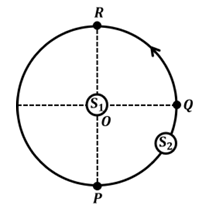
$$S_1$$ and $$S_2$$ are two identical sound sources of frequency 656 Hz. The source $$S_1$$ is located at O and $$S_2$$ moves anti-clockwise with a uniform speed $$4\sqrt{2}$$ ms$$^{-1}$$ on a circular path around O, as shown in the figure. There are three points P, Q and R on this path such that P and R are diametrically opposite while Q is equidistant from them. A sound detector is placed at point P. The source $$S_1$$ can move along direction OP.
[Given: The speed of sound in air is 324 ms$$^{-1}$$]
When only $$S_2$$ is emitting sound and it is $$Q$$, the frequency of sound measured by the detector in Hz is ____.
Correct Answer: 648
The detector is fixed at point P, so only the motion of the source $$S_2$$ (real frequency $$f = 656\;\text{Hz}$$) produces the Doppler shift.
Geometry of the situation
Take the centre $$O$$ of the circle as the origin, the radius of the circle as $$r$$ and let the positive $$x$$-axis pass through P.
• Coordinates: $$P(r,0),\;Q(0,r),\;R(-r,0)$$ (P and R are opposite, Q is equidistant).
• At Q the position vector of $$S_2$$ is $$\vec{r}_Q=(0,r)$$.
• Since $$S_2$$ moves anticlockwise with speed $$u = 4\sqrt2\;\text{m s}^{-1}$$, its velocity at Q is tangential and directed along negative $$x$$:
$$\vec{u}_s = (-4\sqrt2,\,0)\;\text{m s}^{-1}$$.
Component of source velocity along the line Q → P
Vector from Q to P: $$\vec{QP} = (r,\, -r)$$.
Unit vector from Q to P:
$$\hat{n} = \frac{\vec{QP}}{|\vec{QP}|}= \frac{(r,\,-r)}{r\sqrt2}= \left(\frac1{\sqrt2},\,-\frac1{\sqrt2}\right).$$
Radial component of the source velocity,
$$u_r = \vec{u}_s \!\cdot\! \hat{n} =
(-4\sqrt2,\,0)\!\cdot\!\left(\frac1{\sqrt2},\,-\frac1{\sqrt2}\right)
= (-4\sqrt2)\!\left(\frac1{\sqrt2}\right)= -4\;\text{m s}^{-1}.$$
The negative sign means $$S_2$$ is moving \emph{away} from the detector along the line of sight at 4 m s$$^{-1}$$.
Doppler formula for a stationary observer and a moving source
If the source recedes with speed $$u_r$$, the observed frequency is
$$f' = \frac{v}{\,v + |u_r|\,}\;f,$$
where $$v = 324\;\text{m s}^{-1}$$ is the speed of sound.
Substituting the values, $$f' = \frac{324}{324 + 4}\times 656 = \frac{324}{328}\times 656 = 0.987804878\times 656 = 648\;\text{Hz}.$$
Therefore, when only $$S_2$$ is emitting and it is at Q, the detector measures a frequency of 648 Hz.
Was this solution helpful?
Create a FREE account and get:
_1.webp)

Educational materials for JEE preparation

Ask our AI anything

AI can make mistakes. Please verify important information.
AI can make mistakes. Please verify important information.
