
Join Our JEE Preparation Group
Prep with like-minded aspirants; Get access to free daily tests and study material.
Sign in
Please select an account to continue using cracku.in
↓ →
Join Our JEE Preparation Group
Prep with like-minded aspirants; Get access to free daily tests and study material.
The velocity of sound in a gas, in which two wavelengths $$4.08$$ m and $$4.16$$ m produce $$40$$ beats in $$12$$ s, will be
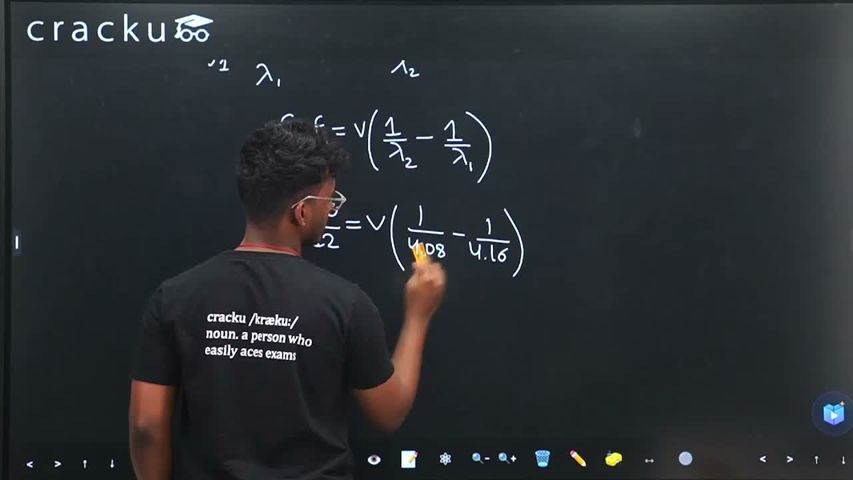
Two wavelengths $$\lambda_1 = 4.08$$ m and $$\lambda_2 = 4.16$$ m produce 40 beats in 12 seconds, giving a beat frequency of $$\frac{40}{12} = \frac{10}{3}$$ beats per second. Expressing the individual frequencies in terms of velocity, $$f_1 = \frac{v}{\lambda_1} = \frac{v}{4.08}$$ and $$f_2 = \frac{v}{\lambda_2} = \frac{v}{4.16}$$; since $$\lambda_1 < \lambda_2$$, we have $$f_1 > f_2$$.
Using the beat frequency relation $$f_1 - f_2 = \frac{10}{3}$$ yields
$$ \frac{v}{4.08} - \frac{v}{4.16} = \frac{10}{3} $$
which can be written as
$$ v\left(\frac{1}{4.08} - \frac{1}{4.16}\right) = \frac{10}{3} $$
Simplifying the bracket gives $$\frac{1}{4.08} - \frac{1}{4.16} = \frac{4.16 - 4.08}{4.08 \times 4.16} = \frac{0.08}{16.9728} = 4.7134 \times 10^{-3}$$, and hence
$$ v = \frac{10}{3 \times 4.7134 \times 10^{-3}} = \frac{10}{0.014140} $$
$$v = 707.2$$ m/s
The correct answer is Option D.
Was this solution helpful?
Click on the Email ☝️ to Watch the Video Solution
Create a FREE account and get:
_1.webp)

Educational materials for JEE preparation

Ask our AI anything

AI can make mistakes. Please verify important information.
AI can make mistakes. Please verify important information.
