
Join Our JEE Preparation Group
Prep with like-minded aspirants; Get access to free daily tests and study material.
Sign in
Please select an account to continue using cracku.in
↓ →
Join Our JEE Preparation Group
Prep with like-minded aspirants; Get access to free daily tests and study material.
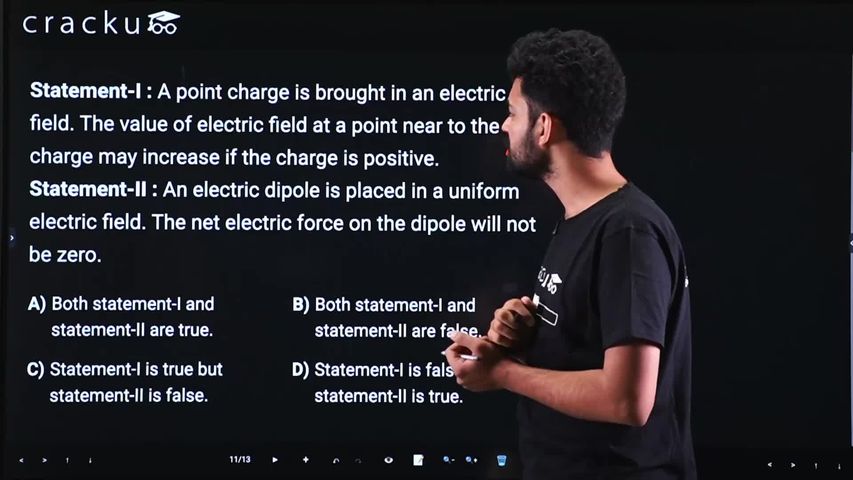
Statement-I : A point charge is brought in an electric field. The value of electric field at a point near to the charge may increase if the charge is positive.
Statement-II : An electric dipole is placed in a uniform electric field. The net electric force on the dipole will not be zero.
We need to evaluate both statements about electric charges and fields.
Checking Statement I:
When a positive point charge is brought near a point in an existing electric field, the electric field at that point is the vector sum of the original field and the field due to the point charge.
If the point charge is positive and the direction of its field at the given point is along (or has a component along) the original electric field, the net field at that point will increase.
So yes, the value of electric field at a point near the charge may increase if the charge is positive. Statement I is TRUE.
Checking Statement II:
An electric dipole placed in a uniform electric field experiences:
- A torque: $$\vec{\tau} = \vec{p} \times \vec{E}$$
- Net force = $$\vec{0}$$ (since the field is uniform, the forces on the positive and negative charges are equal and opposite)
The net force on the dipole in a uniform field is zero. Statement II is FALSE.
Statement I is true but Statement II is false. The correct answer is Option C.
Was this solution helpful?
Click on the Email ☝️ to Watch the Video Solution
Create a FREE account and get:
_1.webp)

Educational materials for JEE preparation

Ask our AI anything

AI can make mistakes. Please verify important information.
AI can make mistakes. Please verify important information.
