
Join Our JEE Preparation Group
Prep with like-minded aspirants; Get access to free daily tests and study material.
Sign in
Please select an account to continue using cracku.in
↓ →
Join Our JEE Preparation Group
Prep with like-minded aspirants; Get access to free daily tests and study material.
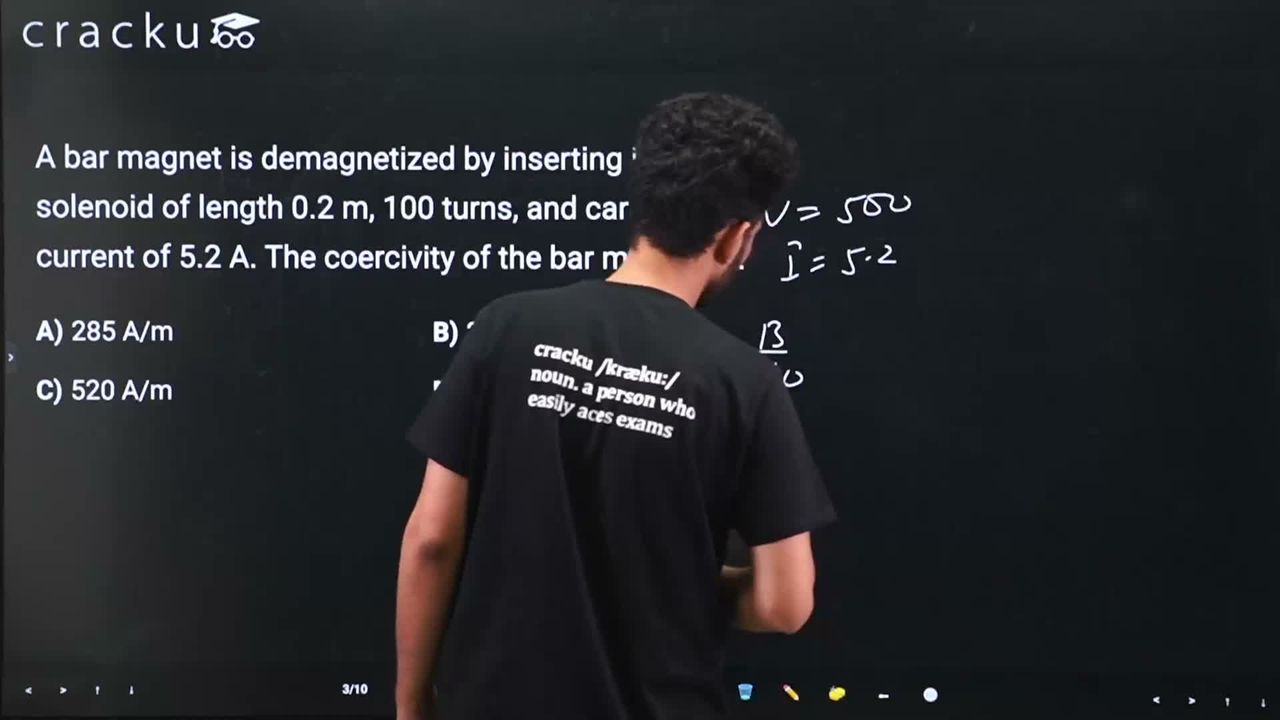
A bar magnet is demagnetized by inserting it inside a solenoid of length 0.2 m, 100 turns, and carrying a current of 5.2 A. The coercivity of the bar magnet is:
We have a bar magnet placed completely inside a current-carrying solenoid. In such a situation the magnetic field acting on the magnet is exactly the field produced by the solenoid itself. To make the magnet lose all its magnetisation, this external field must be equal in magnitude (but opposite in sense) to the magnet’s coercive field. Therefore the coercivity $$H_c$$ of the bar magnet is numerically the same as the magnetising field intensity $$H$$ created by the solenoid.
First we recall the standard formula for the field inside a long solenoid. For a solenoid having $$N$$ turns, length $$\ell$$, and carrying a current $$I$$,
$$B = \mu_0 \, n \, I,$$
where $$n$$ is the number of turns per unit length, $$n = \dfrac{N}{\ell}$$, and $$\mu_0$$ is the permeability of free space. The magnetic field intensity $$H$$ is related to the flux-density $$B$$ by
$$H = \dfrac{B}{\mu_0}.$$
Substituting $$B = \mu_0 n I$$ into this relation gives
$$H = \dfrac{\mu_0 n I}{\mu_0} = n I.$$
Thus, inside a long solenoid,
$$H = n I.$$
Now we substitute the numerical data given in the question. The solenoid has
$$N = 100 \text{ turns}, \qquad \ell = 0.2 \text{ m}.$$
So the turn density is
$$n = \dfrac{N}{\ell} = \dfrac{100}{0.2} = 500 \text{ turns per metre}.$$
The current flowing is
$$I = 5.2 \text{ A}.$$
Therefore the field intensity generated is
$$H = n I = 500 \times 5.2 = 2600 \text{ A/m}.$$
Since this field exactly cancels the magnet’s residual magnetism, the coercivity of the bar magnet is
$$H_c = 2600 \text{ A/m}.$$
Hence, the correct answer is Option 2.
Was this solution helpful?
Click on the Email ☝️ to Watch the Video Solution
Create a FREE account and get:
_1.webp)

Educational materials for JEE preparation

Ask our AI anything

AI can make mistakes. Please verify important information.
AI can make mistakes. Please verify important information.
