NTA JEE Main 26th February 2021 Shift 2
For the following questions answer them individually
NTA JEE Main 26th February 2021 Shift 2 - Question 11
A particle executes S.H.M., the graph of velocity as a function of displacement is:
NTA JEE Main 26th February 2021 Shift 2 - Question 12
A tuning fork $$A$$ of unknown frequency produces 5 beats s$$^{-1}$$ with a fork of known frequency 340 Hz. When fork $$A$$ is filed, the beat frequency decreases to 2 beats s$$^{-1}$$. What is the frequency of fork $$A$$?
NTA JEE Main 26th February 2021 Shift 2 - Question 13
Given below are two statements
Statement I: An electric dipole is placed at the centre of a hollow sphere. The flux of electric field through the sphere is zero, but the electric field is not zero anywhere in the sphere.
Statement II: If $$R$$ is the radius of a solid metallic sphere and $$Q$$ be the total charge on it. The electric field at any point on the spherical surface of radius $$r (< R)$$ is zero but the electric flux passing through this closed spherical surface of radius $$r$$ is not.
In the light of the above statements, choose the correct answer from the options given below:

NTA JEE Main 26th February 2021 Shift 2 - Question 14
An aeroplane, with its wings spread 10 m, is flying at a speed of 180 km h$$^{-1}$$ in a horizontal direction. The total intensity of earth's field at that part is $$2.5 \times 10^{-4}$$ Wb m$$^{-2}$$ and the angle of dip is 60°. The emf induced between the tips of the plane wings will be
NTA JEE Main 26th February 2021 Shift 2 - Question 15
Find the peak current and resonant frequency of the following circuit (as shown in figure).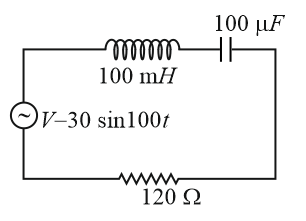
NTA JEE Main 26th February 2021 Shift 2 - Question 16
Given below are two statements: one is labeled as Assertion A and the other is labeled as Reason R.
Assertion A: For a simple microscope, the angular size of the object equals the angular size of the image.
Reason R: Magnification is achieved as the small object can be kept much closer to the eye than 25 cm and hence it subtends a large angle. In the light of the above statements, choose the most appropriate answer from the options given below:
NTA JEE Main 26th February 2021 Shift 2 - Question 17
The incident ray, reflected ray and the outward drawn normal are denoted by the unit vectors $$\vec{a}$$, $$\vec{b}$$ and $$\vec{c}$$ respectively. Then choose the correct relation for these vectors.
NTA JEE Main 26th February 2021 Shift 2 - Question 18
The recoil speed of a hydrogen atom after it emits a photon in going from $$n = 5$$ state to $$n = 1$$ state will be
NTA JEE Main 26th February 2021 Shift 2 - Question 19
A radioactive sample is undergoing $$\alpha$$ decay. At any time $$t_1$$, its activity is $$A$$ and another time $$t_2$$, the activity is $$\frac{A}{5}$$. What is the average life time for the sample?
NTA JEE Main 26th February 2021 Shift 2 - Question 20
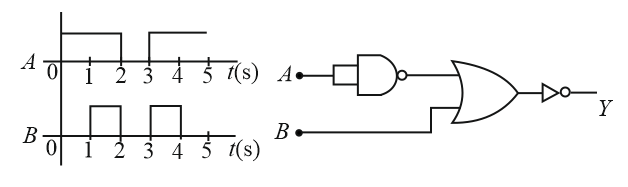
Draw the output signal Y in the given combination of gates.