
Join Our JEE Preparation Group
Prep with like-minded aspirants; Get access to free daily tests and study material.
Sign in
Please select an account to continue using cracku.in
↓ →
Join Our JEE Preparation Group
Prep with like-minded aspirants; Get access to free daily tests and study material.
A wire of 1 $$\Omega$$ has a length of 1 m. It is stretched till its length increases by 25%. The percentage change in resistance to the nearest integer is:
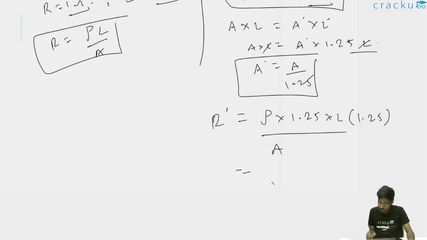
The resistance of a wire is given by $$R = \frac{\rho L}{A}$$, where $$\rho$$ is the resistivity, $$L$$ is the length, and $$A$$ is the cross-sectional area. When the wire is stretched, its volume remains constant, so $$LA = L'A'$$.
The original length is $$L = 1$$ m and the original resistance is $$R = 1 \, \Omega$$. After stretching, the new length is $$L' = 1.25L = 1.25$$ m. Since volume is conserved, $$A' = \frac{LA}{L'} = \frac{A}{1.25}$$.
The new resistance is $$R' = \frac{\rho L'}{A'} = \frac{\rho (1.25L)}{A/1.25} = \rho \frac{L}{A} \times (1.25)^2 = R \times 1.5625 = 1.5625 \, \Omega$$.
The percentage change in resistance is $$\frac{R' - R}{R} \times 100 = \frac{1.5625 - 1}{1} \times 100 = 56.25\%$$, which to the nearest integer is $$56\%$$.
Was this solution helpful?
Click on the Email ☝️ to Watch the Video Solution
Create a FREE account and get:
_1.webp)

Educational materials for JEE preparation

Ask our AI anything

AI can make mistakes. Please verify important information.
AI can make mistakes. Please verify important information.


