Join Our JEE Preparation Group
Prep with like-minded aspirants; Get access to free daily tests and study material.
Sign in
Please select an account to continue using cracku.in
↓ →
Join Our JEE Preparation Group
Prep with like-minded aspirants; Get access to free daily tests and study material.
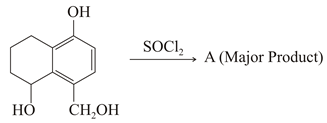
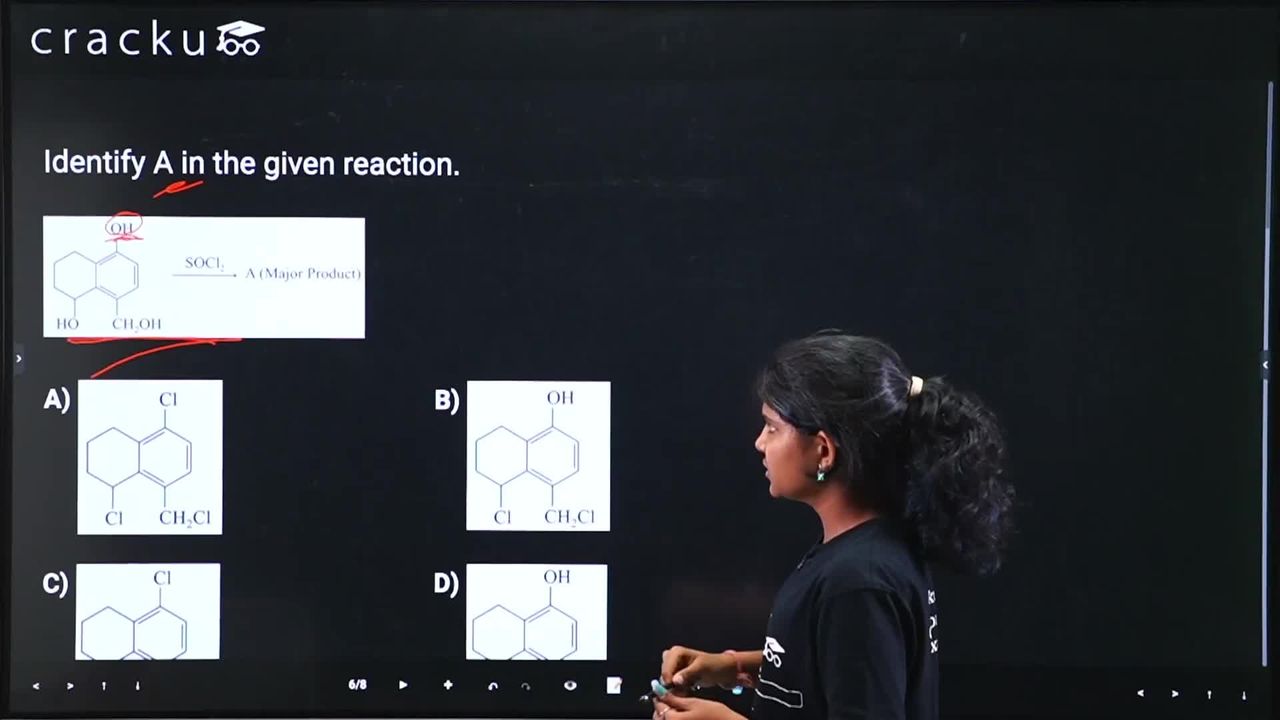
The phenolic -OH group (the one attached directly to the benzene ring) does not react with thionyl chloride ($SOCl_2$) due to resonance stabilization. The lone pairs of electrons on the phenolic oxygen atom delocalize into the $\pi$-system of the adjacent benzene ring. This resonance interaction grants the carbon-oxygen (C-O) bond a partial double-bond character. Because of this partial double bond, the C-O bond is significantly stronger and much harder to cleave than a standard single bond. Additionally, $SOCl_2$ replaces hydroxyl groups via a nucleophilic substitution mechanism that requires an $sp^3$ hybridized carbon; it cannot successfully attack the $sp^2$ hybridized carbon of an aromatic ring. Therefore, the phenolic -OH remains untouched, while the other two aliphatic -OH groups (which are on $sp^3$ carbons and have standard, easily broken single bonds) will be successfully replaced by chlorine atoms.
Was this solution helpful?
Click on the Email ☝️ to Watch the Video Solution
Create a FREE account and get:
_1.webp)

Educational materials for JEE preparation

Ask our AI anything

AI can make mistakes. Please verify important information.
AI can make mistakes. Please verify important information.