Join Our JEE Preparation Group
Prep with like-minded aspirants; Get access to free daily tests and study material.
Sign in
Please select an account to continue using cracku.in
↓ →
Join Our JEE Preparation Group
Prep with like-minded aspirants; Get access to free daily tests and study material.
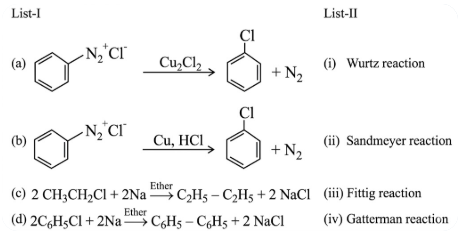
$$C_6H_5N_2^+Cl^- \xrightarrow{Cu_2Cl_2} C_6H_5Cl + N_2$$
$$2CH_3CH_2Cl + 2Na \xrightarrow{\text{Ether}} C_2H_5-C_2H_5 + 2NaCl$$
$$2C_6H_5Cl + 2Na \xrightarrow{\text{Ether}} C_6H_5-C_6H_5 + 2NaCl$$
(a)→(ii), (b)→(iv), (c)→(i), (d)→(iii)
The correct match is the above. The correct option is option D.
Was this solution helpful?
Create a FREE account and get:
_1.webp)

Educational materials for JEE preparation

Ask our AI anything

AI can make mistakes. Please verify important information.
AI can make mistakes. Please verify important information.