Join Our JEE Preparation Group
Prep with like-minded aspirants; Get access to free daily tests and study material.
Sign in
Please select an account to continue using cracku.in
↓ →
Join Our JEE Preparation Group
Prep with like-minded aspirants; Get access to free daily tests and study material.
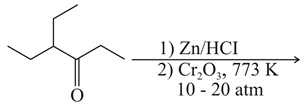
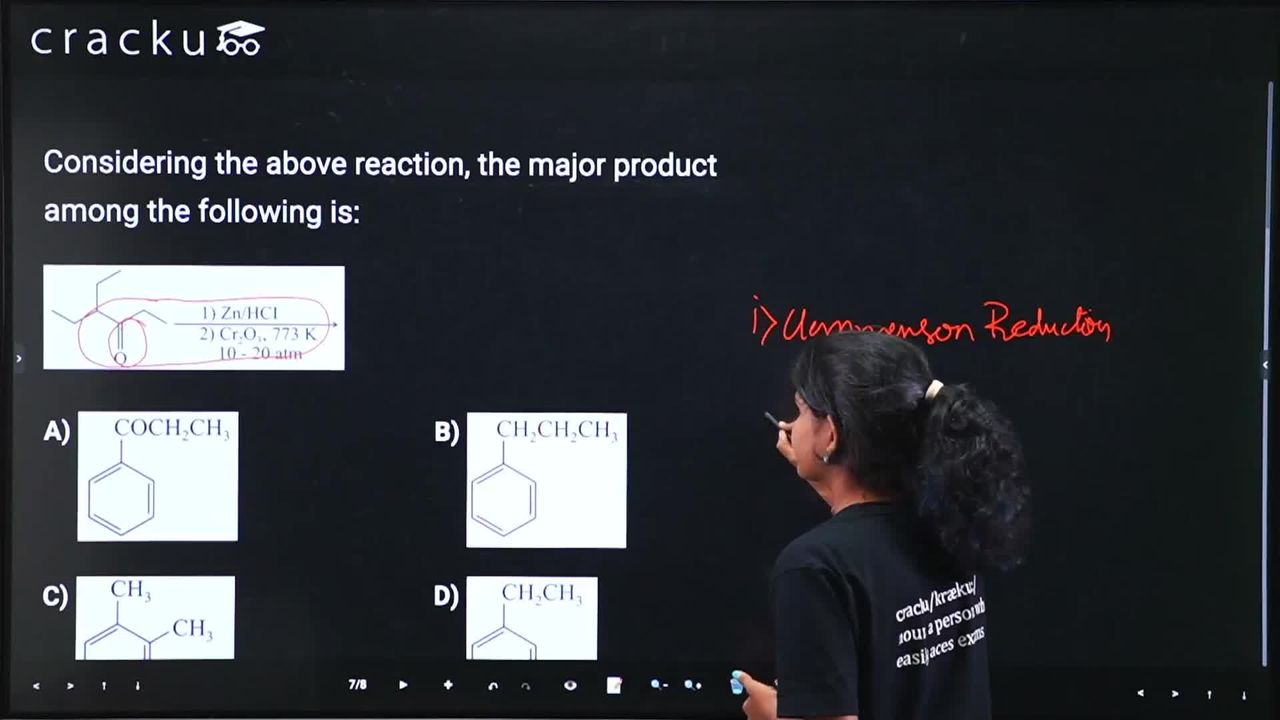
To determine the major product of this reaction sequence, we first identify the starting material as 4-ethylhexan-3-one. The first step utilizes zinc amalgam and hydrochloric acid (Zn/HCl), which are the standard reagents for a Clemmensen reduction. This reduction specifically targets the carbonyl group of the ketone, completely removing the oxygen atom and converting the carbonyl carbon into a simple methylene (-CH2-) group. As a result, the ketone is reduced to its corresponding alkane, forming the intermediate compound 3-ethylhexane.
In the second step, this 3-ethylhexane intermediate is treated with chromium(III) oxide (Cr2O3) at a high temperature of 773 K and a high pressure of 10 to 20 atm. These specific conditions trigger the aromatization (or dehydrocyclization) of alkanes. Because the intermediate contains a continuous chain of six carbon atoms, these severe conditions force the main chain to fold back on itself, eliminating hydrogen gas and forming a highly stable, six-membered aromatic benzene ring.
During the formation of this benzene ring, the ethyl group that was attached to the third carbon of the original hexane chain remains completely intact. It simply transitions into being a substituent attached to the newly formed aromatic ring. Therefore, by combining the newly formed benzene ring with the remaining ethyl group, the final major product of this entire reaction sequence is ethylbenzene.
Was this solution helpful?
Click on the Email ☝️ to Watch the Video Solution
Create a FREE account and get:
_1.webp)

Educational materials for JEE preparation

Ask our AI anything

AI can make mistakes. Please verify important information.
AI can make mistakes. Please verify important information.