Join Our JEE Preparation Group
Prep with like-minded aspirants; Get access to free daily tests and study material.
Sign in
Please select an account to continue using cracku.in
↓ →
Join Our JEE Preparation Group
Prep with like-minded aspirants; Get access to free daily tests and study material.
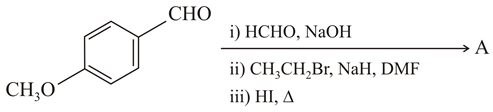
The reaction begins with a crossed Cannizzaro reaction between $$\mathrm{4\text{-}Methoxybenzaldehyde}$$ and $$\mathrm{HCHO}$$ in presence of $$\mathrm{NaOH}$$.
Since neither aldehyde contains $$\mathrm{\alpha}$$-hydrogens, disproportionation occurs.
Formaldehyde is preferentially oxidised to formate, while the aromatic aldehyde is reduced to:
$$\mathrm{4\text{-}Methoxybenzyl\ Alcohol}$$
In the second step, $$\mathrm{NaH}$$ deprotonates the alcohol to form an alkoxide ion.
The alkoxide attacks $$\mathrm{CH_3CH_2Br}$$ through an $$\mathrm{S_N2}$$ mechanism in DMF, forming:
$$\mathrm{4\text{-}Methoxybenzyl\ Ethyl\ Ether}$$
In the final step, concentrated $$\mathrm{HI}$$ and heat cleave both ether linkages.
In the aryl methyl ether, iodide attacks the methyl group, forming a phenol group $$\mathrm{(-OH)}$$.
In the benzylic ether, iodide attacks the benzylic carbon, replacing the ethoxy group with:
$$\mathrm{(-CH_2I)}$$
The final major product contains a phenol group and an iodomethyl group at para positions on the benzene ring.
Correct Option: $$\mathrm{A}$$
Was this solution helpful?
Create a FREE account and get:
_1.webp)

Educational materials for JEE preparation

Ask our AI anything

AI can make mistakes. Please verify important information.
AI can make mistakes. Please verify important information.