Join Our JEE Preparation Group
Prep with like-minded aspirants; Get access to free daily tests and study material.
Sign in
Please select an account to continue using cracku.in
↓ →
Join Our JEE Preparation Group
Prep with like-minded aspirants; Get access to free daily tests and study material.
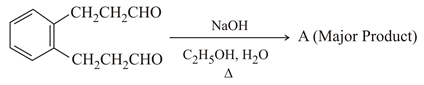
The reaction undergoes an intramolecular aldol condensation.
The starting compound is a dialdehyde containing acidic $$\mathrm{\alpha}$$-hydrogens adjacent to both aldehyde groups.
In the presence of sodium hydroxide:
$$\mathrm{NaOH}$$
one $$\mathrm{\alpha}$$-hydrogen is removed to form a resonance-stabilised enolate ion.
$$\mathrm{R-CH_2-CHO + OH^- \longrightarrow R-CH^- -CHO + H_2O}$$
The enolate ion acts as a nucleophile.
Since another aldehyde group is present within the same molecule, intramolecular nucleophilic attack occurs on the second carbonyl carbon.
$$\mathrm{Enolate + CHO \longrightarrow Cyclic\ \beta\text{-}Hydroxy\ Aldehyde}$$
Because the two side chains are ortho-substituted on the benzene ring, they remain close together, favouring cyclisation.
This forms a new seven-membered ring fused to the benzene ring.
On heating:
$$\mathrm{\Delta}$$
the cyclic $$\mathrm{\beta}$$-hydroxy aldehyde undergoes dehydration.
$$\mathrm{\beta\text{-}Hydroxy\ Aldehyde \longrightarrow \alpha,\beta\text{-}Unsaturated\ Aldehyde + H_2O}$$
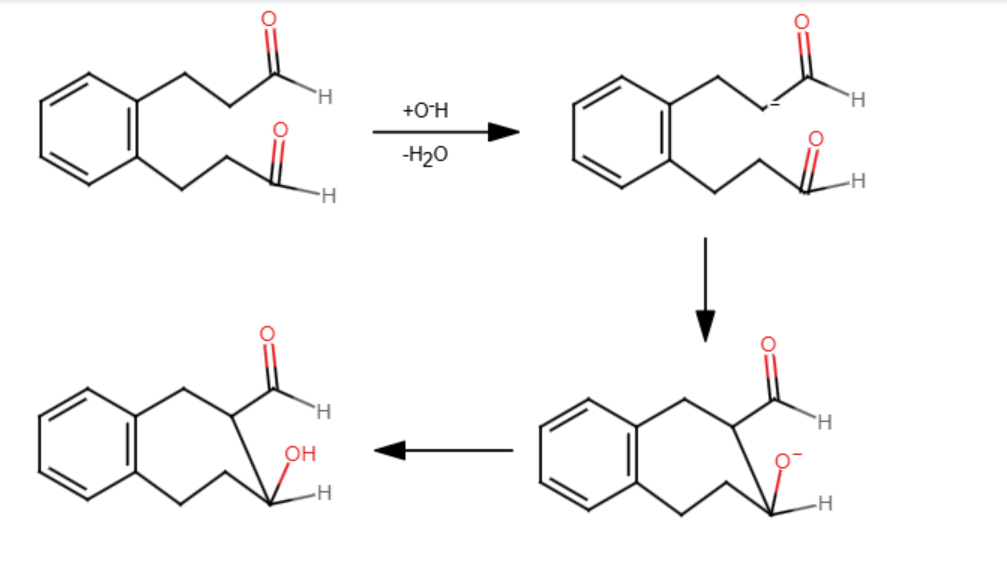
Dehydration of this product gives us the required answer.
The final product contains:
1. A fused seven-membered ring
2. An $$\mathrm{\alpha,\beta}$$-unsaturated double bond
3. Conjugation with the remaining aldehyde group
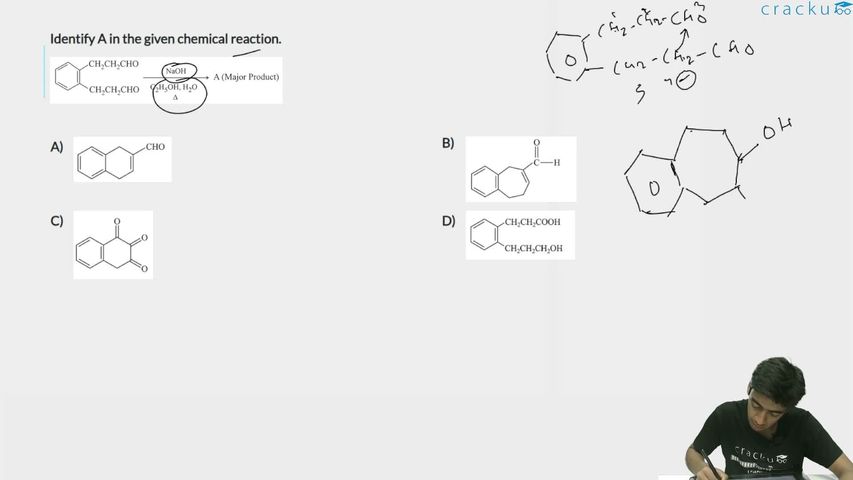
Therefore, the major product $$\mathrm{A}$$ is the conjugated cyclic $$\mathrm{\alpha,\beta}$$-unsaturated aldehyde.
Was this solution helpful?
Click on the Email ☝️ to Watch the Video Solution
Create a FREE account and get:
_1.webp)

Educational materials for JEE preparation

Ask our AI anything

AI can make mistakes. Please verify important information.
AI can make mistakes. Please verify important information.