
Join Our JEE Preparation Group
Prep with like-minded aspirants; Get access to free daily tests and study material.
Sign in
Please select an account to continue using cracku.in
↓ →
Join Our JEE Preparation Group
Prep with like-minded aspirants; Get access to free daily tests and study material.
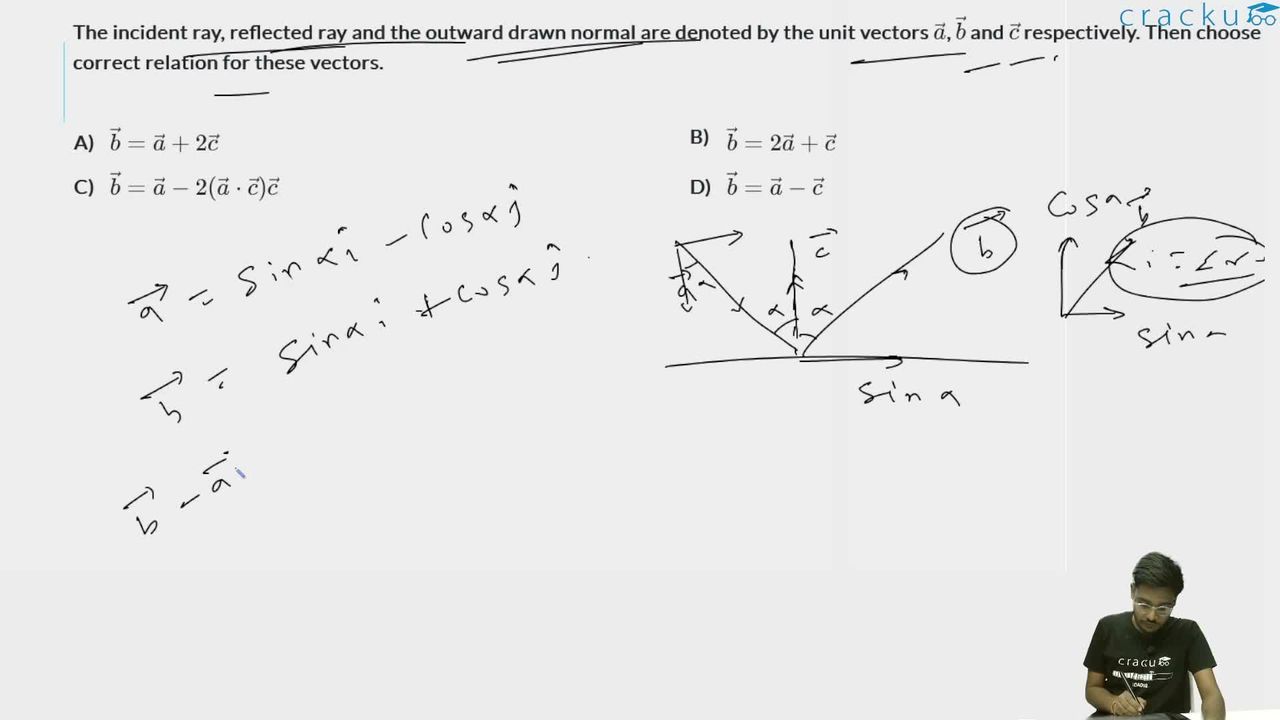
The incident ray, reflected ray and the outward drawn normal are denoted by the unit vectors $$\vec{a}$$, $$\vec{b}$$ and $$\vec{c}$$ respectively. Then choose the correct relation for these vectors.
Let $$\vec{a}$$ be the unit vector along the incident ray, $$\vec{b}$$ be the unit vector along the reflected ray, and $$\vec{c}$$ be the unit vector along the outward drawn normal to the reflecting surface.
By the law of reflection, the component of the incident ray along the surface (tangential component) remains unchanged, while the component along the normal reverses direction.
The component of $$\vec{a}$$ along the normal is $$(\vec{a} \cdot \vec{c})\vec{c}$$. Since the incident ray points toward the surface, $$\vec{a} \cdot \vec{c} < 0$$. The tangential component of $$\vec{a}$$ is $$\vec{a} - (\vec{a} \cdot \vec{c})\vec{c}$$.
For the reflected ray, the tangential component stays the same and the normal component reverses: $$\vec{b} = \vec{a} - (\vec{a} \cdot \vec{c})\vec{c} - (\vec{a} \cdot \vec{c})\vec{c} = \vec{a} - 2(\vec{a} \cdot \vec{c})\vec{c}$$.
This gives the standard reflection formula: $$\vec{b} = \vec{a} - 2(\vec{a} \cdot \vec{c})\vec{c}$$.
Was this solution helpful?
Click on the Email ☝️ to Watch the Video Solution
Create a FREE account and get:
_1.webp)

Educational materials for JEE preparation

Ask our AI anything

AI can make mistakes. Please verify important information.
AI can make mistakes. Please verify important information.


