
Join Our JEE Preparation Group
Prep with like-minded aspirants; Get access to free daily tests and study material.
Sign in
Please select an account to continue using cracku.in
↓ →
Join Our JEE Preparation Group
Prep with like-minded aspirants; Get access to free daily tests and study material.
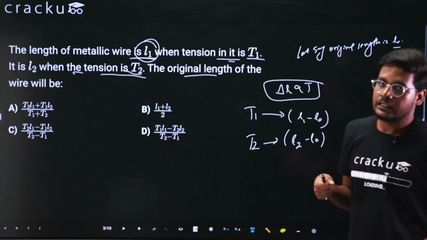
The length of metallic wire is $$l_1$$ when tension in it is $$T_1$$. It is $$l_2$$ when the tension is $$T_2$$. The original length of the wire will be:
Let the original (natural) length of the wire be $$l_0$$ and the cross-sectional area be $$A$$. When a tension $$T$$ is applied, the extension is $$\Delta l = \frac{Tl_0}{YA}$$, where $$Y$$ is Young's modulus.
When tension $$T_1$$ is applied, the length becomes $$l_1 = l_0 + \frac{T_1 l_0}{YA}$$, which gives $$l_1 - l_0 = \frac{T_1 l_0}{YA}$$ ... (i).
When tension $$T_2$$ is applied, the length becomes $$l_2 = l_0 + \frac{T_2 l_0}{YA}$$, which gives $$l_2 - l_0 = \frac{T_2 l_0}{YA}$$ ... (ii).
Dividing equation (i) by equation (ii): $$\frac{l_1 - l_0}{l_2 - l_0} = \frac{T_1}{T_2}$$.
Cross-multiplying: $$T_2(l_1 - l_0) = T_1(l_2 - l_0)$$, which gives $$T_2 l_1 - T_2 l_0 = T_1 l_2 - T_1 l_0$$. Rearranging: $$l_0(T_1 - T_2) = T_1 l_2 - T_2 l_1$$, so $$l_0 = \frac{T_1 l_2 - T_2 l_1}{T_1 - T_2} = \frac{T_2 l_1 - T_1 l_2}{T_2 - T_1}$$.
Was this solution helpful?
Click on the Email ☝️ to Watch the Video Solution
Create a FREE account and get:
_1.webp)

Educational materials for JEE preparation

Ask our AI anything

AI can make mistakes. Please verify important information.
AI can make mistakes. Please verify important information.


