
Join Our JEE Preparation Group
Prep with like-minded aspirants; Get access to free daily tests and study material.
Sign in
Please select an account to continue using cracku.in
↓ →
Join Our JEE Preparation Group
Prep with like-minded aspirants; Get access to free daily tests and study material.
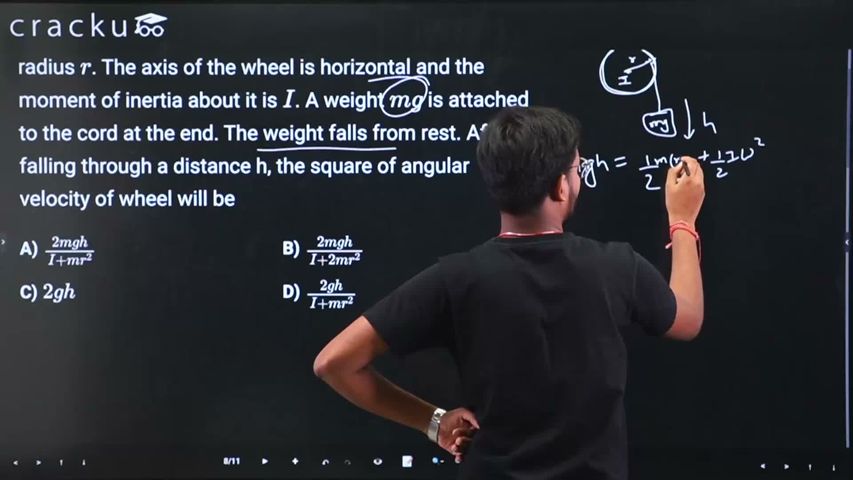
A cord is wound round the circumference of wheel of radius $$r$$. The axis of the wheel is horizontal and the moment of inertia about it is $$I$$. A weight $$mg$$ is attached to the cord at the end. The weight falls from rest. After falling through a distance h, the square of angular velocity of wheel will be
We use conservation of energy. The weight $$mg$$ falls through a distance $$h$$, losing potential energy $$mgh$$. This energy is converted into the rotational kinetic energy of the wheel and the translational kinetic energy of the falling mass.
The velocity of the falling mass is related to the angular velocity of the wheel by $$v = r\omega$$, since the cord is wound around the wheel of radius $$r$$.
By conservation of energy: $$mgh = \frac{1}{2}I\omega^2 + \frac{1}{2}mv^2 = \frac{1}{2}I\omega^2 + \frac{1}{2}m(r\omega)^2 = \frac{1}{2}(I + mr^2)\omega^2$$.
Solving for $$\omega^2$$: $$\omega^2 = \frac{2mgh}{I + mr^2}$$.
Was this solution helpful?
Click on the Email ☝️ to Watch the Video Solution
Create a FREE account and get:
_1.webp)

Educational materials for JEE preparation

Ask our AI anything

AI can make mistakes. Please verify important information.
AI can make mistakes. Please verify important information.


