
Join Our JEE Preparation Group
Prep with like-minded aspirants; Get access to free daily tests and study material.
Sign in
Please select an account to continue using cracku.in
↓ →
Join Our JEE Preparation Group
Prep with like-minded aspirants; Get access to free daily tests and study material.
Let $$\alpha$$ and $$\beta$$ be two real numbers such that $$\alpha + \beta = 1$$ and $$\alpha\beta = -1$$. Let $$p_n = (\alpha)^n + (\beta)^n$$, $$p_{n-1} = 11$$ and $$p_{n+1} = 29$$ for some integer $$n \geq 1$$. Then, the value of $$p_n^2$$ is ______.
Correct Answer: 324
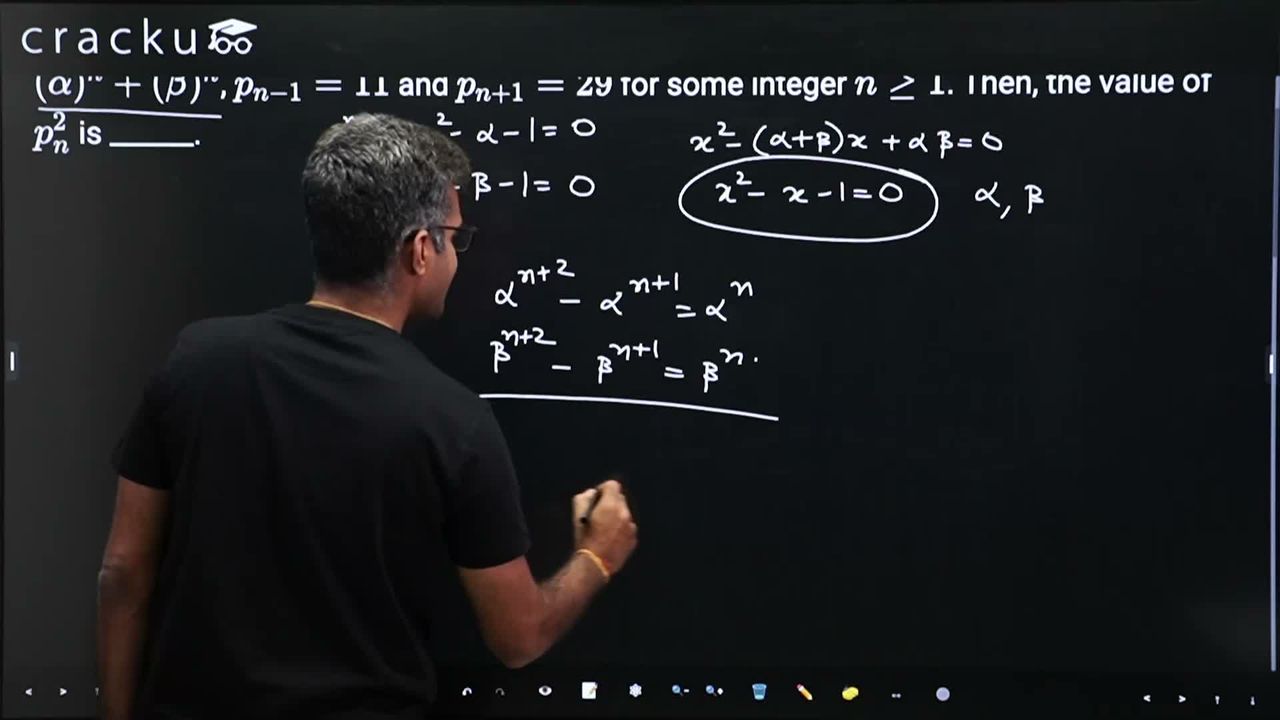
Since $$\alpha$$ and $$\beta$$ are roots of a quadratic with $$\alpha + \beta = 1$$ and $$\alpha\beta = -1$$, they satisfy $$t^2 - t - 1 = 0$$. The sequence $$p_n = \alpha^n + \beta^n$$ satisfies Newton's identity recurrence: $$p_{n+1} = (\alpha + \beta)p_n - \alpha\beta \cdot p_{n-1}$$.
Substituting the given values: $$p_{n+1} = 1 \cdot p_n - (-1) \cdot p_{n-1} = p_n + p_{n-1}$$.
We are given $$p_{n-1} = 11$$ and $$p_{n+1} = 29$$. Using the recurrence $$p_{n+1} = p_n + p_{n-1}$$, we substitute: $$29 = p_n + 11$$.
Solving for $$p_n$$: $$p_n = 29 - 11 = 18$$.
We can verify this is consistent by checking with the recurrence in the other direction. We also know $$p_0 = \alpha^0 + \beta^0 = 2$$ and $$p_1 = \alpha + \beta = 1$$. Using $$p_{k+1} = p_k + p_{k-1}$$, the sequence begins: $$p_0 = 2, p_1 = 1, p_2 = 3, p_3 = 4, p_4 = 7, p_5 = 11, p_6 = 18, p_7 = 29, \ldots$$ So $$n - 1 = 5$$, i.e., $$n = 6$$, and indeed $$p_6 = 18$$ and $$p_7 = 29$$.
Therefore, $$p_n^2 = 18^2 = 324$$.
Was this solution helpful?
Click on the Email ☝️ to Watch the Video Solution
Create a FREE account and get:
_1.webp)

Educational materials for JEE preparation

Ask our AI anything

AI can make mistakes. Please verify important information.
AI can make mistakes. Please verify important information.
