
Join Our JEE Preparation Group
Prep with like-minded aspirants; Get access to free daily tests and study material.
Sign in
Please select an account to continue using cracku.in
↓ →
Join Our JEE Preparation Group
Prep with like-minded aspirants; Get access to free daily tests and study material.
The trajectory of a projectile in a vertical plane is $$y = \alpha x - \beta x^2$$, where $$\alpha$$ and $$\beta$$ are constants and $$x$$ & $$y$$ are respectively the horizontal and vertical distances of the projectile from the point of projection. The angle of projection $$\theta$$ and the maximum height attained $$H$$ are respectively given by
The trajectory of the projectile is given by $$y = \alpha x - \beta x^2$$.
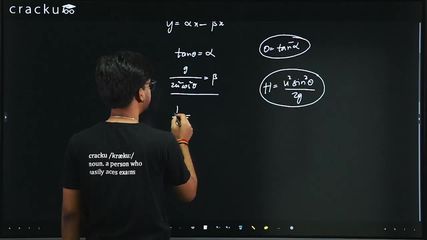
The angle of projection $$\theta$$ is the angle the velocity makes with the horizontal at the point of projection $$(x = 0)$$. Since $$\tan\theta = \frac{dy}{dx}\bigg|_{x=0}$$, we differentiate: $$\frac{dy}{dx} = \alpha - 2\beta x$$. At $$x = 0$$, $$\frac{dy}{dx} = \alpha$$, so $$\tan\theta = \alpha$$, which gives $$\theta = \tan^{-1}\alpha$$.
The maximum height occurs where $$\frac{dy}{dx} = 0$$, i.e., $$\alpha - 2\beta x = 0$$, giving $$x = \frac{\alpha}{2\beta}$$.
Substituting this into the trajectory equation: $$H = \alpha \cdot \frac{\alpha}{2\beta} - \beta \cdot \left(\frac{\alpha}{2\beta}\right)^2 = \frac{\alpha^2}{2\beta} - \frac{\alpha^2}{4\beta} = \frac{\alpha^2}{4\beta}$$.
Therefore, the angle of projection is $$\tan^{-1}\alpha$$ and the maximum height is $$\frac{\alpha^2}{4\beta}$$.
Was this solution helpful?
Click on the Email ☝️ to Watch the Video Solution
Create a FREE account and get:
_1.webp)

Educational materials for JEE preparation

Ask our AI anything

AI can make mistakes. Please verify important information.
AI can make mistakes. Please verify important information.


